Shopify 9 min read
WhatsApp Chatbot for Shopify Returns: A Practical Guide
Last updated: 3 November 2026.
A WhatsApp chatbot for Shopify returns should do three things well: explain the policy in plain language, collect the details your team needs, and hand off exceptions without pretending it can make a judgement call. It should not approve a return just because a customer types “I want to return this.”
For a Shopify store, return messages rarely arrive as tidy support tickets. They come as “This size does not fit,” “Can I exchange this?”, “My parcel came damaged,” or “When will my refund arrive?” The first response decides whether the customer gets a clear next step or starts chasing your team across WhatsApp, email and Instagram.
ZynfoAI helps Shopify stores answer customers on WhatsApp Business and website chat using the policies and product information the store provides. When a request needs a person, the conversation can be handed to your team with the context already collected. For the broader channel setup, read the WhatsApp AI agent for Shopify stores guide.
What should a WhatsApp chatbot answer about returns?
Start with questions that have a published, consistent answer. These are the messages that keep repeating and should not need a person every time:
- Is this item eligible for return or exchange?
- What is the return window?
- Is an item required to be unused or in its original packaging?
- Which details should the customer share to start a request?
- Where can the customer find the store’s return instructions?
- Has the team received the return request?
The chatbot should answer only from your current returns policy, not from a generic rule it invents. If your policy says final-sale products are not returnable, the response should say that plainly. If it does not cover damaged items, the chatbot should collect photos and an order reference, then route the conversation to a person.
That boundary matters. A return policy is a set of business rules. An exception is a decision.
Why WhatsApp return conversations get messy
Return conversations often begin after the customer has already received a delivery update, asked a sizing question, or spoken to someone on a different channel. The customer does not care which team owns the next step. They want to know what happens now.
A weak process makes them repeat the order number, product, reason and photos. A clear process captures those once and tells the customer exactly what happens next.
| Customer message | Good first response | What should happen next |
|---|---|---|
| “Can I return this?” | Explain the relevant return window and condition from your policy | Ask for the order number and item |
| “The item is damaged” | Acknowledge the issue and request the information your team needs | Send to a person with the order reference and photos |
| “I need another size” | Explain whether exchanges are available and what the policy requires | Collect the item and requested size |
| “Where is my refund?” | Explain the store’s stated refund timeline and confirm the next support step | Route to the team if a status lookup is needed |
This is not about making the chat sound clever. It is about making the next step obvious.
The return flow to set up before you automate anything
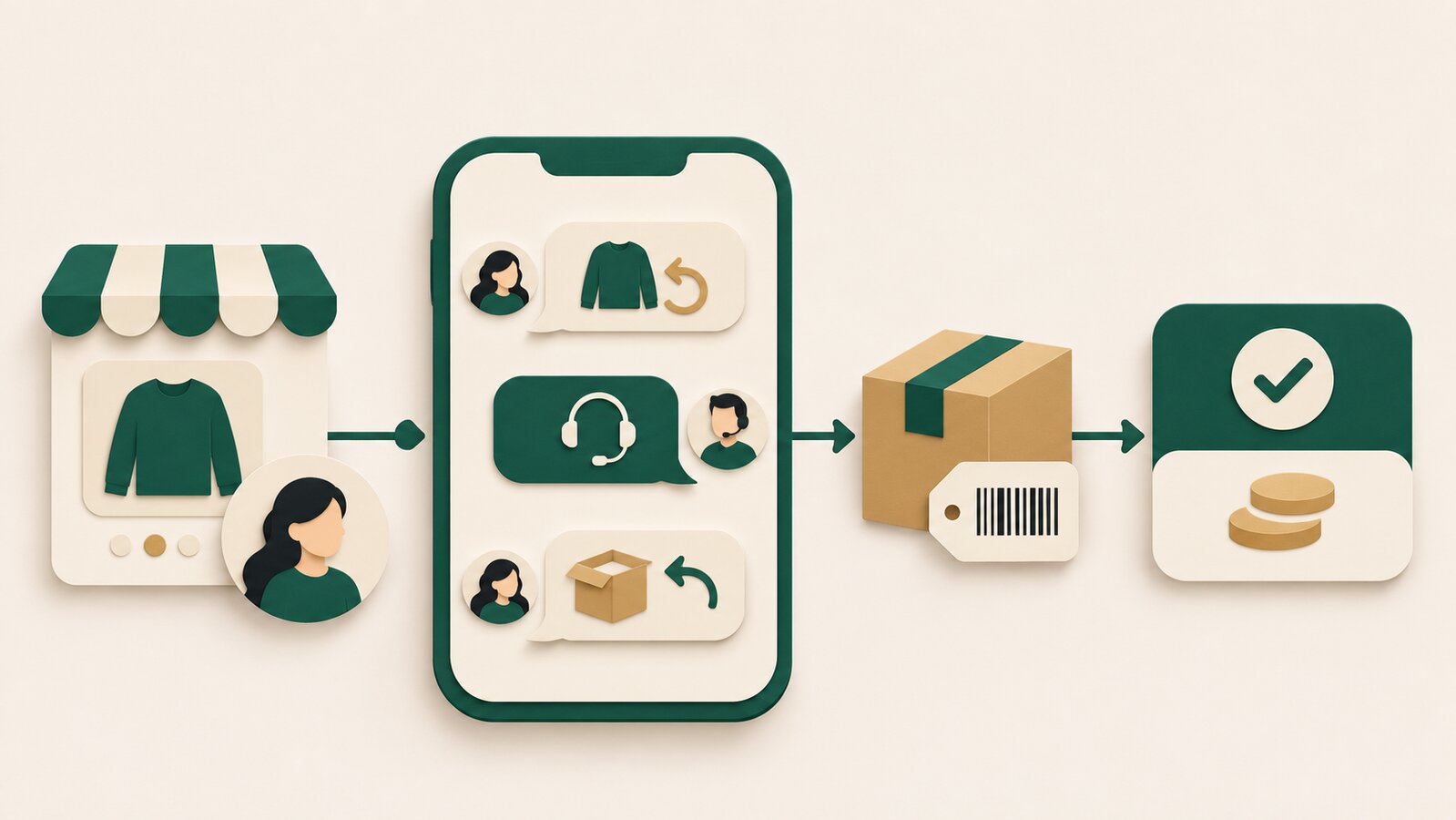
Write the flow before connecting it to WhatsApp. A useful return flow has four parts.
1. Put one current policy in writing
Your support team, website and WhatsApp replies should all use the same source. Include the return window, product-condition rules, exclusions, exchange process, shipping responsibility and the point at which a refund is issued.
Do not bury key conditions in a PDF no one can find. The chatbot can only give a reliable answer when the policy itself is clear.
2. Decide which messages the chatbot can finish
A chatbot can finish a conversation when the answer is already in the policy. It can also collect details for a request.
It should not decide cases that need discretion, such as whether a damaged item qualifies, whether a late request deserves an exception, or whether a refund has been processed if it cannot verify that status. Those should go to a person.
The same rule applies to order queries. The WhatsApp order-tracking guide for Shopify explains the difference between sending a tracking update and answering a customer who asks for one.
3. Collect only the details your team will use
For a basic return request, that is usually:
- Order number
- Item to return or exchange
- Reason for the request
- Photos, when damage is reported
- The customer’s preferred outcome: return, exchange or clarification
Avoid turning WhatsApp into a long form. Ask for one missing detail at a time and tell the customer why you need it.
4. Route the exception with context
When a case needs a person, the handoff should include the conversation history and the details already collected. The customer should not be asked to begin again.
Human handoff is especially important for damaged goods, policy exceptions, high-value orders and customers who are already frustrated. See how chatbot-to-human takeover should work for the operational side of that handoff.
A practical example: a size exchange on WhatsApp
Imagine a customer writes: “I need to exchange the medium for a large.”
A useful response is not “Our team will contact you shortly.” It is:
We can help with that. Exchanges are available within the window shown in our returns policy, provided the item meets the listed conditions. Please share your order number and the item you would like to exchange.
Once the customer shares the order number, the chatbot can collect the item and requested size. If your team needs to confirm stock or eligibility, it should say so. It should not promise an exchange before that check is complete.
That is the principle for every return flow: be helpful, specific and honest about what happens next.
How to make return answers useful without overpromising
Use these rules when you write your WhatsApp replies:
- Name the policy, not a guess. “Our policy allows returns within 14 days” is useful only if that is your actual policy.
- Separate guidance from approval. “Here is how to request a return” is different from “Your return is approved.”
- Explain the next action. Tell customers what to send, where to find the policy or when the team will respond.
- Do not hide exceptions. If a request needs review, say that directly.
- Keep the same answer across channels. A customer should not get one rule on WhatsApp and another through website chat.
For questions that arrive late at night, the same approach still works. The chatbot can answer policy questions and collect the request, while your team reviews exceptions in the morning. Read how to handle WhatsApp support after office hours for that setup.
Which Shopify return questions should still go to a person?
Not every return question belongs in automation. Route these cases to a person:
| Situation | Why it needs review |
|---|---|
| Damaged or wrong item | The team may need evidence, replacement stock or a carrier claim |
| Request outside the return window | This is an exception decision, not a policy lookup |
| Partial refund or goodwill request | It requires judgement |
| Missing return parcel | The team may need carrier or warehouse information |
| Customer disputes the policy | A person should own the conversation |
| High-value or repeat-order customer | The right resolution may depend on the relationship |
An AI agent is useful when it removes the repeated admin work around these cases. It does not need to replace the person who makes the final call.
How does this connect to lower support volume?
Most return conversations have two parts: a repeat question and a decision. The repeat question is usually policy, process or status. The decision is usually an exception.
If the repeat part gets an immediate, accurate answer, your team starts with fewer incomplete messages. If the exception arrives with the order reference, item, reason and images already attached, they spend less time collecting basics.
That is a better goal than trying to automate every return. It makes the customer’s path clearer and preserves control where your team needs it.
If “where is my order?” is also filling your inbox, pair this flow with the guide to reduce Shopify order-status tickets. The two questions often arrive from the same post-purchase customer, but they need different answers.
FAQ
Can a WhatsApp chatbot approve Shopify returns automatically?
It should only do that if your store has explicitly defined rules and the system is connected to the information needed to verify them. For most stores, the safer use is to explain the policy, collect the request details and send exceptions to a person for approval.
What information should a chatbot collect for a return request?
Start with the order number, item, reason and desired outcome. Ask for photos when the customer reports damage. Keep the questions limited to what your team actually needs to review the case.
Can a chatbot answer refund-status questions?
It can explain the refund timeline in your published policy and collect the order reference. If it cannot verify the refund status from a connected system, it should route the conversation to your team rather than guess.
How do I keep WhatsApp return replies accurate?
Use one up-to-date return policy as the source for your website and chatbot. Review it whenever your return window, exclusions or process changes. Make exceptions a human-review path.
What should happen when the chatbot cannot answer?
The customer should be handed to a person with the conversation context and details already collected. They should not be asked to repeat the same information.
Tools and guides
Put this into practice
AI WhatsApp Reply Generator
Generate high-converting, professional WhatsApp sales and support replies with AI.
SolutionWhatsApp AI Chatbot Platform
Automate customer support and sales over official WhatsApp Business API.
Free ToolWhatsApp Chat Widget Generator
Build a custom floating WhatsApp button to embed on WordPress or Shopify.
FeatureAI with Human Handoff
Escalate complex chats to live agents with complete conversation context.