WhatsApp Automation 12 min read
Diwali Sale WhatsApp Support: A Shopify Store Checklist
Last updated: 23 October 2026.
Diwali sale WhatsApp support comes down to one job: answering the same few questions quickly while orders pile up. In 2026, Diwali’s main day, Lakshmi Puja, falls on 8 November, with Dhanteras on 6 November and Bhai Dooj on 10 November (Wikipedia). If you run a Shopify store in India, the week around those dates is when your WhatsApp fills up. This checklist shows what to set up before then, in the order a customer meets it.
ZynfoAI is an AI customer service agent for Shopify stores that answers customers on WhatsApp Business and website chat. It costs from $39 a month, with no per-resolution or per-seat fees, and a 7-day free trial with no card. For the full picture of how one AI agent covers a store’s WhatsApp, see our guide to the WhatsApp AI agent for Shopify stores.
What do customers ask on WhatsApp during a Diwali sale?
Most messages are the same five questions: where is my order, when will it arrive before the festival, can I change the address, is the item in stock, and what happens with cash on delivery. These repeat all day and late into the night, so a small team falls behind quickly. Plan for these five first.
Here is each one in the words a customer actually types:
- “Where is my order?” The most common message. The customer ordered, the parcel is quiet, and the gift is for a fixed day.
- “Will it reach before Dhanteras?” A delivery date question. The honest answer depends on the pincode and the courier.
- “Can I change the address?” Often a gift sent to a relative in another city.
- “Is this in stock in the other colour?” A product question, usually asked while the customer is deciding.
- “I chose cash on delivery. What happens now?” Cash on delivery (COD) is a problem you manage as a store owner. Customers want to know when to expect a call or a courier, and what to keep ready.
Each of these has an answer already sitting in your store: the order record, your shipping page or your catalog. That is why they suit an AI agent that reads your own data. They do not need a person to look them up one by one.
How many messages should you plan for?
Plan from your own history, not from an industry average. Take your last sale, count the WhatsApp chats per day, and add a margin for Diwali being bigger. No outside number replaces that count, and a made-up one would only give you false comfort.
A simple method:
- Open WhatsApp Business or your inbox and count chats on your busiest day last sale.
- Count how many of those were order status questions, as a share of the day.
- Multiply the busiest day by how much bigger you expect this sale to be.
- Divide by the number of people who answer. That is each person’s load on the peak day.
If one person’s load is more than they can answer in a working day, you need either more people or an agent that answers first. This is the number that tells you whether to prepare now.
Why does WhatsApp get busy at night?
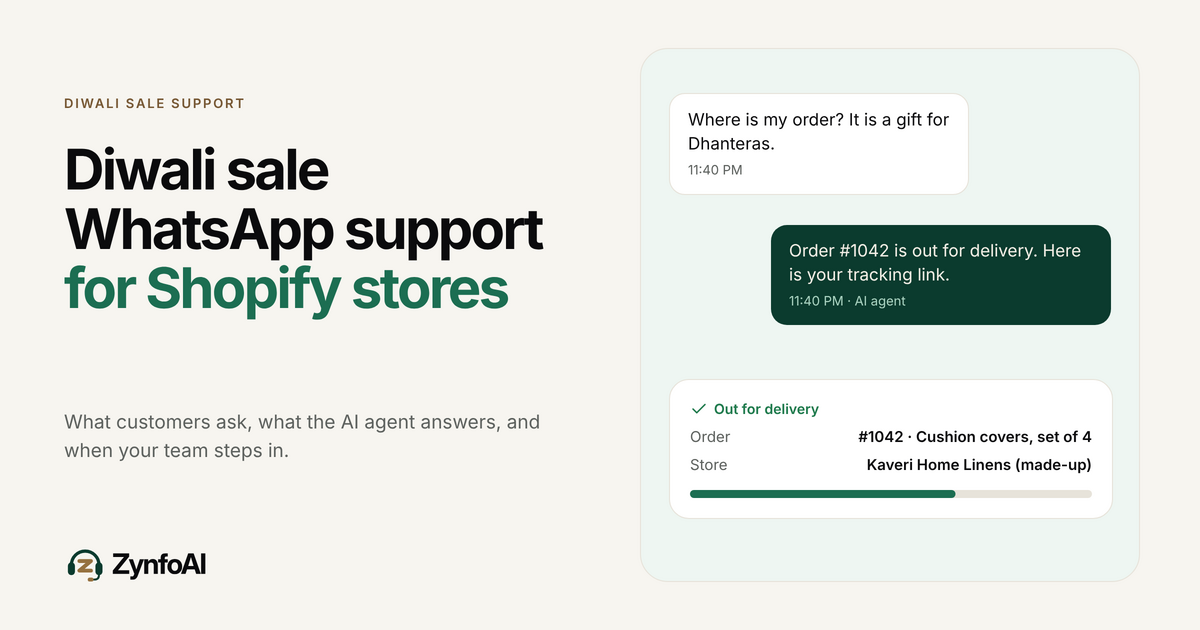
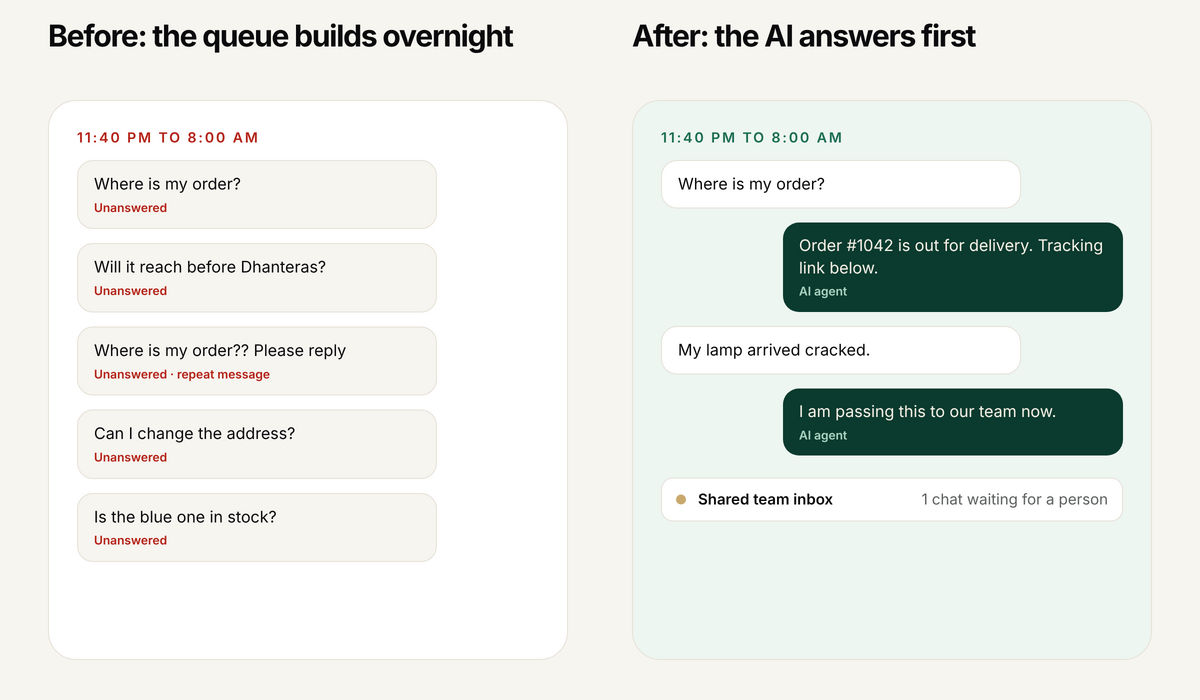
Customers shop after work and after dinner, so messages arrive when your team is offline. A customer who writes at 11:40 PM and hears nothing until the morning often writes again, and then a third time. Those repeat messages double your count without adding a single new question.
This is the moment an AI agent earns its place. It answers at night from your store’s own data, and anything it cannot answer becomes a help-desk ticket for your team with the full chat history. Your team starts the morning with a short list of real problems instead of a long list of repeated ones.
What does the WhatsApp 24-hour window mean for a sale week?
When a customer messages you, WhatsApp opens a 24-hour customer service window. Inside it, your replies are free-form. Once it closes, only approved template messages can reach that customer, and utility templates sent outside the window are charged. Meta explains this in its WhatsApp pricing documentation.
For a sale this means one thing: a fast first reply keeps you inside the window. If a customer writes at night and you reply at noon the next day, you have lost half the window before you start. Our guide to WhatsApp Business API pricing in 2026 covers the charges in full. Meta’s charges are separate from any tool you use.
How do you answer “where is my order?” before it is asked?
Send the tracking link when the parcel ships, and keep the status updates on. Shopify sends three shipping emails: shipping confirmation when you fulfil the order, then “out for delivery” and “delivered” when the carrier reports those events. Shopify notes that tracking event sources, accuracy and timing vary by carrier (Shopify Help Center).
Two habits matter in a sale week:
- Fulfil in Shopify the day the parcel leaves. Shipping confirmation is triggered by fulfilment, not by a courier scan. If you fulfil a day late, the customer waits a day longer for their link.
- Say the cut-off date on the product page. “Order by 3 November for Diwali delivery in metro cities” removes a whole class of messages. Only state a date you can keep.
For the questions that still arrive, an AI agent that tracks orders answers from the store’s order data. Our WISMO guide for Shopify lists five fixes in the order a customer meets them, and the order tracking page shows how ZynfoAI handles the chat lookup. Order tracking applies to online stores.
When should the AI hand a chat to a person?
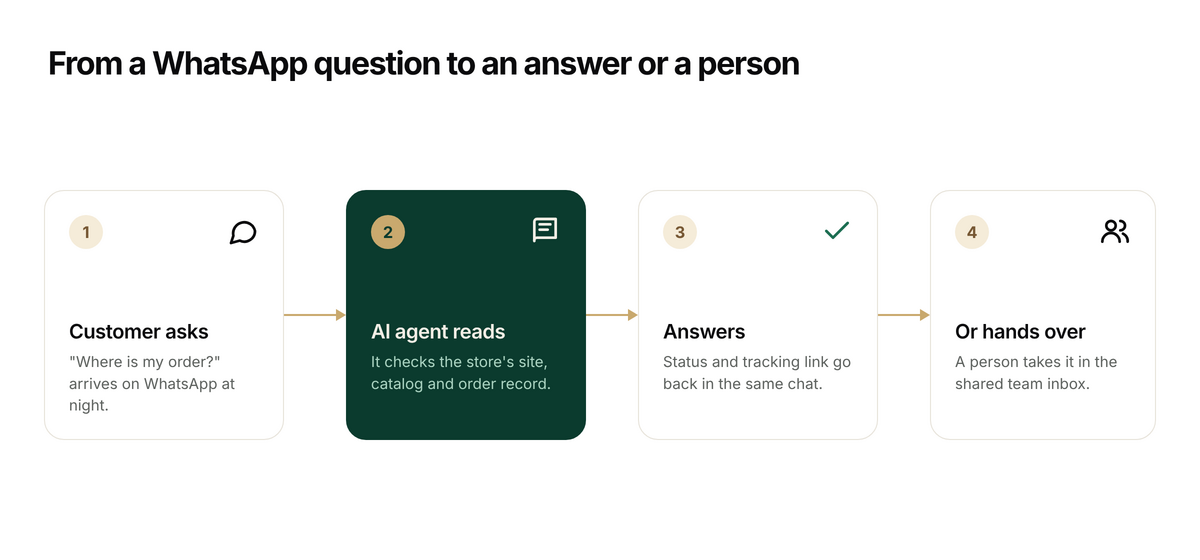
Hand over when the question needs judgement or the AI has no source for the answer. A damaged festive gift, an angry customer, an address change on a shipped order and a wrong item are all human jobs. Setting this up before the sale keeps the AI from guessing in front of a customer.
Write the hand-over list on paper before sale week. A good starting list:
- The customer asks for a person, in any wording.
- The message mentions damage, a wrong item or a refund dispute.
- The order was placed on COD and the customer wants to change how they pay or where it goes.
- The AI has no source in your site, documents or catalog.
In ZynfoAI, a question the AI agent cannot answer becomes a help-desk ticket for your team, with the chat history attached. Live chat handoff, where a person takes over the WhatsApp chat, is on the Pro plan. Read how WhatsApp human takeover works for the questions to ask any vendor.
Which tool should answer first: the AI or your team?
Let the AI answer first for questions it can source, and let your team own everything else. Your team keeps the human touch for gifts gone wrong, and the AI covers the repeated lookups at night. The split depends on how many people you have and when they are online.
| Situation | Who answers first | Why |
|---|---|---|
| Order status, tracking link | AI agent | The answer sits in the order record |
| Delivery date before the festival | AI agent, if your shipping page states it | It needs a source you control |
| Product questions | AI agent | It reads the Shopify catalog |
| Damaged or wrong item | Person | Needs judgement and a decision |
| Angry customer | Person | Needs a human tone and ownership |
| COD change after dispatch | Person | Needs the courier and your rules |
How does a flat price help in a festive sale?
A flat price means the sale’s volume does not change your bill. Some tools charge for each conversation the AI resolves, so a busy week is the most expensive week. ZynfoAI costs from $39 a month, with no per-resolution fees, so a good Diwali does not raise the support bill.
A simple example, with an assumed rate that is not any vendor’s price. Say a store’s AI resolves 1,200 chats in the sale month, and a tool charges $1 per resolution. That is $1,200 for the month. On a flat plan, the bill stays the same as in a quiet month. Change the numbers to your own: the point is that per-resolution pricing grows with your success. Our post on flat rate versus per-resolution fees walks through how to compare plans. Support that scales. Your bill doesn’t.
A worked example: a made-up home linen store
Take a made-up Shopify store, Kaveri Home Linens, selling bedsheets and cushion covers from Jaipur. It has two people on support. Last Diwali, WhatsApp filled up on the three evenings before the festival, and the team answered tracking questions until midnight.
This year the owner does the following, in two evenings:
- Adds the shipping page, with an order cut-off date and a delivery estimate for metro and non-metro pincodes.
- Connects the website and Shopify catalog so the AI agent learns the store’s own pages and products.
- Writes the hand-over list above and shares it with both support people.
- Tests five real questions on WhatsApp, including one the page cannot answer, to check that the AI opens a ticket instead of guessing.
- Decides who works the ticket queue each evening of 5, 6, 7 and 8 November.
On the night of 6 November, a customer writes at 11:40 PM asking where her order is. The AI agent reads the order, replies with the status and the tracking link, and the customer goes to sleep. A second customer reports a cracked lamp. That chat becomes a help-desk ticket with the full history, and one of the two people picks it up in the morning.
Can you send WhatsApp campaigns for the sale as well?
Yes. WhatsApp broadcast campaigns are on the Pro plan. Keep the sale message short, and make sure customers who reply get answered by the same AI agent as your support chats. The details of the feature are on the WhatsApp campaigns page.
One caution: campaigns bring replies. A sale announcement at 7 PM can produce a wave of questions at 7:05 PM. Set up the support side first, then send.
What should you finish before 6 November?
Finish the shipping page, connect your store, write the hand-over list, test the chat and plan the ticket shifts. That is five jobs, and none needs a developer. Do them in this order, and keep the tests last so you can fix gaps while there is still time.
Our guide to evaluating Shopify AI support gives a longer buying checklist if you are comparing tools. If you want to try ZynfoAI, you can start the trial and test the agent on your own store before the sale.
Checklist: Diwali sale WhatsApp support
- I counted my busiest WhatsApp day from the last sale.
- My shipping page states the order cut-off date and delivery estimates.
- I fulfil orders in Shopify the day the parcel leaves.
- The AI agent learns from my website, documents and Shopify catalog.
- I wrote the hand-over list and shared it with my team.
- Someone is on the ticket queue every evening from 5 to 10 November.
- I tested five real questions on WhatsApp, including one the AI cannot answer.
- I know the price, the trial and the money-back terms before I commit.
FAQ
When is Diwali in 2026?
Lakshmi Puja, the main day of Diwali, is on 8 November 2026. The five-day festival runs from 6 November (Dhanteras) to 10 November (Bhai Dooj), according to Wikipedia. Confirm exact timings for your city.
What do customers ask most during a Diwali sale?
Order status, delivery before the festival, address changes, stock questions and cash on delivery questions. These repeat all day, which is why the answers should come from your order data and your shipping page.
Can an AI agent answer WhatsApp messages at night?
Yes. ZynfoAI answers customers on WhatsApp Business at any hour, using your website, documents and Shopify catalog. A question it cannot answer becomes a help-desk ticket for your team. Our guide to WhatsApp support after office hours shows how to set up the night shift.
What does ZynfoAI cost during a sale?
ZynfoAI costs from $39 a month, with no per-resolution fees, so a busy sale week does not raise the bill. Meta’s WhatsApp message charges are separate. See the pricing page.
Do I need to hire for the sale?
That depends on your count. Use your busiest day from the last sale as the starting point. If one person cannot answer that load in a working day, add either people or an AI agent that answers first.
How do I try it before the sale?
Start the 7-day free trial at zynfo.ai, with no card. Train the agent on your store and test your five questions. There is also a 15-day money-back guarantee.
Tools and guides
Put this into practice
AI WhatsApp Reply Generator
Generate high-converting, professional WhatsApp sales and support replies with AI.
SolutionWhatsApp AI Chatbot Platform
Automate customer support and sales over official WhatsApp Business API.
Free ToolWhatsApp Chat Widget Generator
Build a custom floating WhatsApp button to embed on WordPress or Shopify.
FeatureAI with Human Handoff
Escalate complex chats to live agents with complete conversation context.