AI Agents 6 min read
SaaS vs AaaS: What Changes When Agents Do the Work

SaaS (software as a service) rents you a tool that your team operates. AaaS (agent as a service) rents you an AI agent that does a defined job with your tools, while your team sets the rules and checks the result. The difference is who does the work, and that one change moves the pricing, the risk and what you are buying.
1. The SaaS paradox
A helpdesk is classic SaaS. It organises tickets, but a person still reads “Where’s my order #1042?”, opens Shopify, finds the order and types the reply. You pay for the software and you still do the work. The tool makes that person faster, but the person still does the job.
For years that was fine, because nothing else could read a customer’s message and act on it. That is the part that has changed.
2. What is AaaS?
AaaS is software that does a job for you. An agent reads the message, looks up order #1042, replies with the tracking status, and passes the chat to a person when it can’t help. Your team stops being the operator and becomes the supervisor.
You still buy it like software, with a sign-up, a plan and a monthly bill. What you are paying for is the job done, within limits you set.
3. SaaS vs AaaS: a head-to-head comparison
| SaaS | AaaS | |
|---|---|---|
| Who does the work | Your team, inside the software | An AI agent, with your team supervising |
| What you buy | Access to features | A job done, such as answering customers |
| Typical pricing | Per seat or per plan | Per plan, per conversation, or per outcome |
| Main risk | Nobody uses it well | The agent does the wrong thing confidently |
| What you manage | People’s time in the tool | The agent’s sources, limits and handoffs |
4. Why traditional SaaS is breaking down
Partly, it isn’t. What is real is that AI agents can now handle narrow, repetitive jobs with clear inputs, such as answering questions from your own help pages, checking an order or qualifying a lead. These jobs used to need a person at a keyboard, and seat-based tools priced around that person. Our explainer on what agentic AI is covers how agents plan and use tools.
The hype is the claim that agents replace software. Every agent runs on software. It needs a store to read orders from, a CRM to write leads to, and an inbox where people pick up what it can’t finish. AaaS is a layer on top of SaaS. Most products sold as AaaS are SaaS with an agent inside, priced on a monthly plan.
“Fully autonomous” is hype too. An agent that can refund an order or promise a delivery date can be wrong in ways that cost money, so good agent products are built around clear limits.
5. The execution layer: where agents earn their keep
The useful part of an agent is that it acts in the systems you already pay for. It reads the order in Shopify, writes the lead to your CRM, opens the ticket in your helpdesk. That execution layer is where the time savings come from, and also where the risk sits.
Agents earn their keep on high-volume, low-judgement work where a wrong answer is cheap to catch:
- Order status, shipping and return-policy questions in an online store
- Product questions answered from your catalogue and help pages
- First replies to new leads, with a few qualifying questions
- After-hours conversations that would otherwise wait until morning
They are a poor fit for work that depends on judgement, negotiation or relationships: complaints that need an apology and a decision, complex B2B deals, anything with legal or medical consequences. Keep a person on those, and let the agent hand them over early.
Pricing is where the difference shows
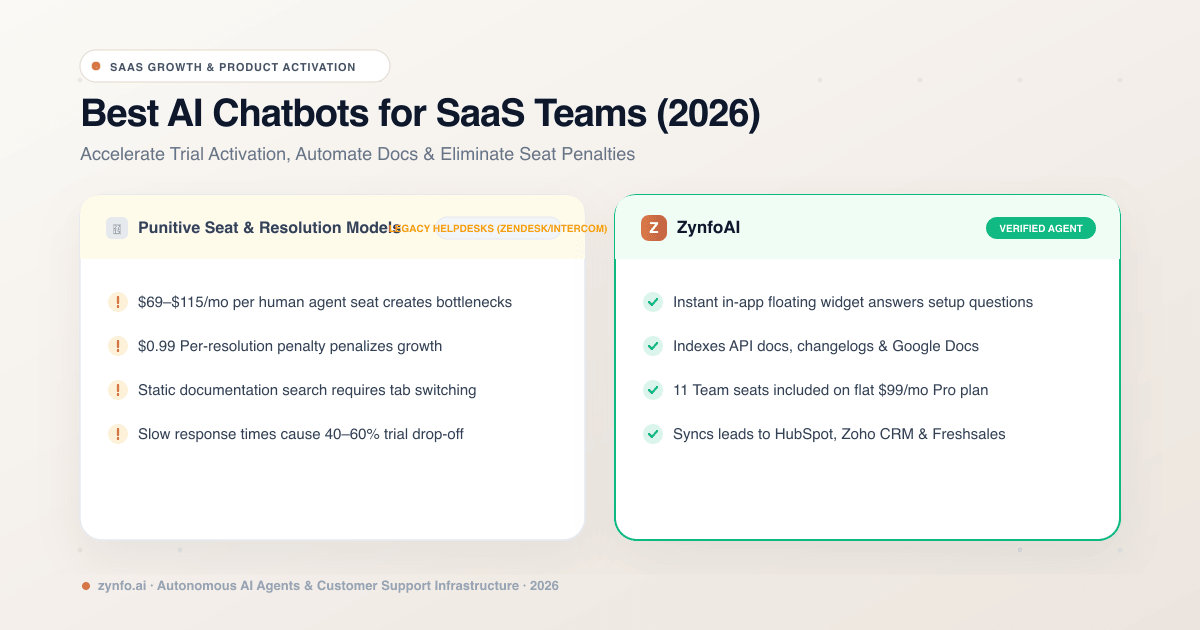
SaaS pricing tracks access: seats, features, plan tiers. Agent pricing tries to track work. Some vendors charge per outcome. Intercom, for example, charges $0.99 per outcome for its Fin AI agent, according to Fin’s pricing page as of October 2026. Others charge per AI conversation, or a flat plan with a usage cap.
Outcome pricing sounds fair, but it moves the risk onto you. The busier you are, the more you pay, and the vendor decides what counts as an outcome. Flat plans are easier to budget, and they cap your volume instead. We break down the trade-offs, with real prices, in flat-rate vs per-resolution AI pricing.
The risks you take on with an agent
With SaaS, the worst case is usually wasted money: a tool nobody opens. With an agent, the worst case is a wrong answer sent to a customer in your name. Before you hand any job to an agent, check four things:
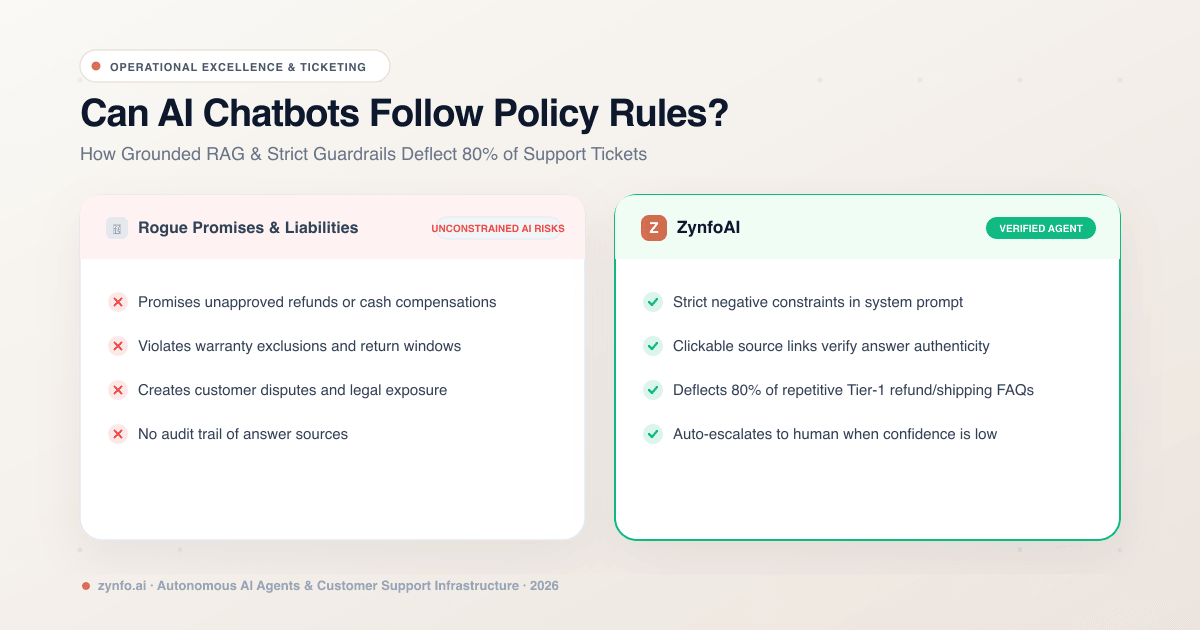
- Where its answers come from. It should answer from your own content and show the source.
- What it is allowed to do. Reading an order is low risk. Cancelling one is not. You should be able to tell which actions it can take.
- When it stops. It should hand the conversation to a person when it isn’t sure, or when the customer asks for one.
- What your team sees. Every conversation should be readable afterwards, so someone can spot mistakes and fix the source.
The third point matters most. An agent that can’t pass a conversation to a person with the context attached creates more work for your team. Our page on chatbot to human handoff shows how that should work.
How ZynfoAI fits
ZynfoAI is an example of the practical version. It is flat pricing with no per-outcome charge, from $39 a month. The agent answers on your website and WhatsApp from your pages and documents, and shows the source. On Shopify it tracks orders and helps customers find products. When it can’t help, the question becomes a help-desk ticket for your team; live chat handoff is on the Pro plan.
It is not a fit if you need the AI to answer SMS or voice calls, or a tool that runs your whole back office. Email support automation is on the Pro plan. See pricing for what the plan includes.
How to start
Start with one job. “Answer order-status questions on WhatsApp” is a good first job, while “Automate customer support” is too broad to measure. Give the agent your real content, watch its conversations for a week, fix the gaps, and only then widen what it is allowed to do. That is the honest version of moving from SaaS to AaaS.
Topics
Tools and guides
Put this into practice
Free Schema Markup Generator
Create valid JSON-LD structured data for Google rich snippets in seconds.
SolutionChatbots vs Static Forms
Replace static contact forms with conversational AI flows that qualify leads as they chat.
Free ToolChatbot ROI Calculator
Calculate your projected cost savings, ticket deflection rate, and revenue impact.
FeatureAI with Human Handoff
Escalate complex chats to live agents with complete conversation context.