WhatsApp 10 min read
WhatsApp Business API Pricing 2026: What Changed Oct 1
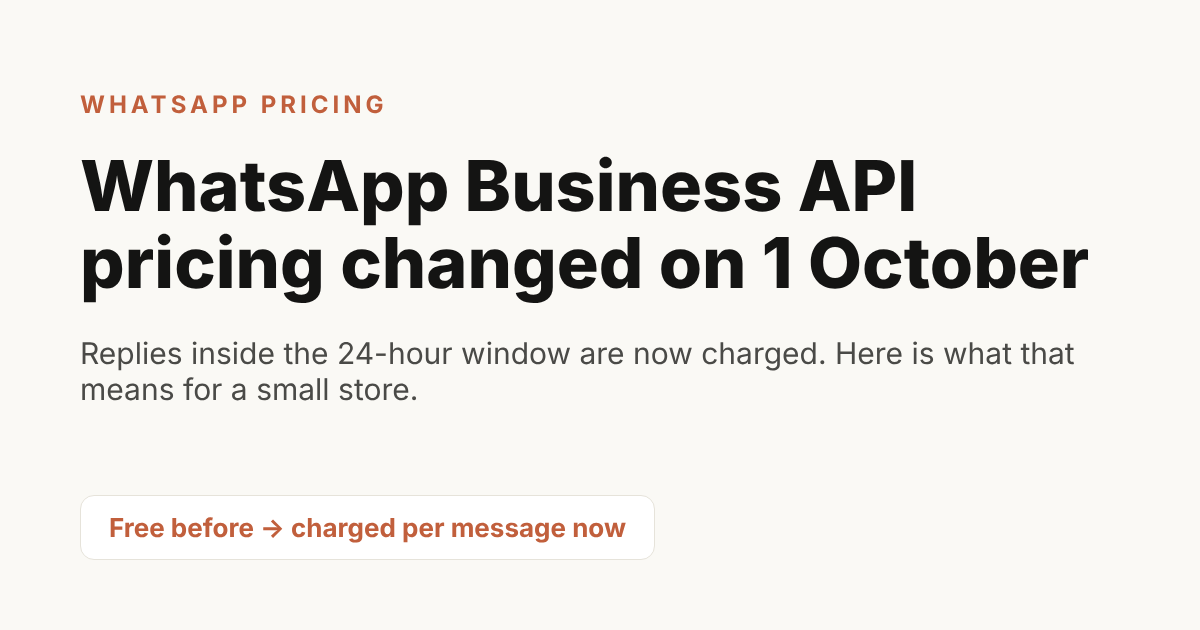
WhatsApp Business API pricing changed on 1 October 2026: Meta now charges per message for free-form replies sent inside the 24-hour customer service window, and for utility templates sent in that window. Both were free before. If you answer customers on WhatsApp, every reply your team or your AI agent sends can now carry a small Meta charge. This guide explains what is charged, shows a worked example for a small store, and lists what to ask any provider before you sign.
Last updated: 6 October 2026
You do not need to be technical to follow this. If you run an online store, an institute or a local service business and answer “where is my order?” all day, you will see how to estimate your own bill in about five minutes.
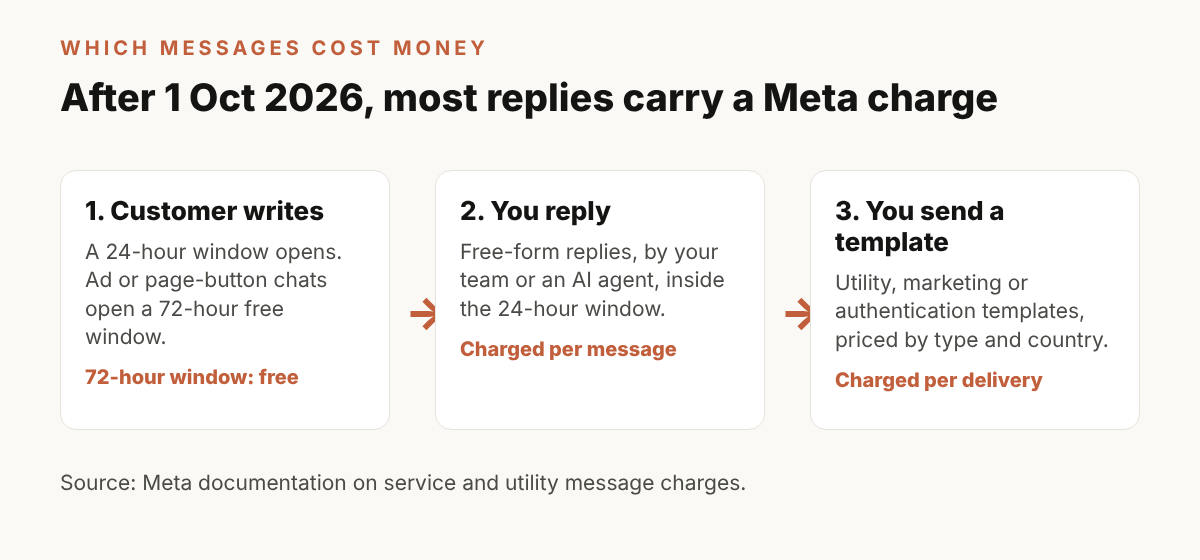
What changed in WhatsApp Business API pricing on 1 October 2026?
Starting 1 October 2026, Meta charges per message for service messages, which are free-form replies you send while a customer’s 24-hour window is open. Utility templates sent inside that window are also charged now. Until 30 September 2026, both were free. Marketing and authentication templates were already charged.
This comes from Meta’s own documentation. Meta’s page on charging for service and utility messages says Meta will “charge on a per-message basis for service messages”, at the same market rates as utility and authentication messages, with no volume tiers for service messages.
One more point from the same page: messages inside the 72-hour free entry point window are still free. That window opens when a customer reaches you through a Click to WhatsApp ad or a page button.
Which WhatsApp messages cost money now?
Four things decide the cost: who started the chat, how much time has passed, whether you used a template, and what the template is for. In short, free-form replies and utility templates inside the 24-hour window are now charged, marketing and authentication templates are charged, and replies inside a 72-hour free entry point window are free.
Here is the plain version:
| Message type | When it is sent | Charged since 1 Oct 2026? |
|---|---|---|
| Service message (free-form reply) | Inside the 24-hour window after a customer writes | Yes. Was free. |
| Utility template (order update, delivery alert) | Inside the 24-hour window | Yes. Was free. |
| Utility template | Outside the window | Yes, as before |
| Marketing template (offers, restock alerts) | Any time | Yes, as before |
| Authentication template (one-time codes) | Any time | Yes, as before |
| Any message type | Inside a 72-hour free entry point window | Free |
Treat the table as a summary, not a rate card. Rates differ by country and change over time, so read Meta’s current rate card for your market before you plan a budget.
How much does a WhatsApp service message cost in India?
Reported rates for India are about ₹0.115 for a utility or service message, plus 18 percent GST, with Meta billing in rupees. Some providers also report 1,000 free service messages per number each month. Meta’s page does not mention that allowance, so confirm it with your provider before counting on it.
MyOperator’s India pricing guide lists ₹0.8631 for marketing, ₹0.115 for utility and authentication, and says service messages are charged at the utility rate from 1 October 2026. It is a provider’s blog, not Meta’s rate card, so treat the numbers as a guide and check the rate card before you commit.
Two things to remember:
- Meta’s rate is not the whole bill. Many providers add a platform fee or a markup on top of Meta’s rate.
- GST applies. The same guide notes that 18 percent GST applies to Meta’s charges and to the provider’s platform fees.
What will this cost a small store? A worked example
Take a Shopify store in Pune with 1,200 WhatsApp conversations a month. Most are “where is my order?”, “do you have size M?” and “can I return this?”. Say each conversation needs about six free-form replies in total. That is 7,200 service messages a month.
Using the reported India rate of ₹0.115 per message and no free allowance, the Meta charge is 7,200 × ₹0.115 = ₹828 a month, before GST. If your provider confirms 1,000 free service messages per number, the charge falls to 6,200 × ₹0.115 = ₹713 a month.
That is an illustration, not a quote. Your number depends on how long your chats run. Count it from your own data in three steps:
- Open your WhatsApp inbox and note how many conversations you had last month.
- Open ten of them and count the replies your side sent. Take the average.
- Multiply conversations by average replies, then by the per-message rate for your country.
You can also try the WhatsApp pricing calculator on this site to check the figures.
The lesson from the example is that long, back-and-forth chats cost more under this model. A reply that answers the question in one go, with the order status in it, is cheaper than three replies asking for the order number first.
Does an AI agent change my WhatsApp costs?
An AI agent does not change Meta’s rates. Every free-form reply it sends inside the window is a service message, charged the same as a reply you type yourself. What changes is how many replies each chat needs, and who has to be awake to send them. Ask each provider how Meta’s charges appear on your bill.
Be careful with vendors that charge per resolved conversation on top. Then you pay twice: once to Meta for each message and once to the vendor for each answer. We cover that model in flat rate versus per-resolution pricing.
ZynfoAI’s published price is $99 a month, flat, with 5,000 conversations and up to 11 team seats included, and no per-resolution fees. See pricing for what is included. How Meta’s own message charges show up on your bill is a separate question, so ask before you start the trial rather than assuming either way.
How do I keep my WhatsApp costs down?
Keep chats short, answer in the first reply, use the free entry point window when you run click-to-WhatsApp ads, and send utility and marketing templates only when they earn their cost. Check your numbers monthly. Four habits cover most of it.
- Answer the real question first. Put the order status, the price or the policy in the first reply.
- Use quick-reply buttons for common choices. A button tap beats three typed questions.
- Use the 72-hour entry window. If you run click-to-WhatsApp ads, replies inside that window are free per Meta.
- Send fewer, better templates. Marketing templates are charged on every delivery. Send them to people who want them.
Our guide to automating WhatsApp replies with AI shows how to set up replies that sound like you, and the WhatsApp AI agent guide covers what an agent can and cannot do there.
What should I ask a WhatsApp provider about pricing?
Ask six questions: does the price include Meta’s charges, what is the markup on Meta’s rate, is there a per-conversation or per-resolution fee, how many team seats are included, what happens when a human takes over, and how are you billed in your own currency. Write the answers down and compare providers side by side.
Use this checklist:
- Is Meta’s per-message charge included in your price, or billed on top?
- What markup, if any, is added to Meta’s rate?
- Is there a fee per resolved conversation, per message or per seat?
- Does the plan cap conversations, and what happens at the cap?
- Can a person on your team take over a chat, and does the AI stop replying while they do?
- Is GST shown separately on the invoice?
On the human handoff point, see how the human handoff works in ZynfoAI, and read about the WhatsApp Business API setup so you know which parts are Meta’s and which are the provider’s.
Is the WhatsApp Business API worth it for a small business?
Yes, for most small businesses that already answer customers on WhatsApp all day. The per-message charge is small next to the cost of missed enquiries. The API route is what lets an AI agent and a shared team inbox work on your number.
It is not for everyone. If you get fewer than a handful of chats a day and answer them yourself, the free app may be enough. If your customers mostly reach you by email or phone, start there. And if your questions are mostly “where is my order?”, look at order tracking before you worry about message fees.
FAQ
Did WhatsApp stop free replies on 1 October 2026?
Not entirely. Meta now charges per message for free-form replies sent inside the 24-hour window, and for utility templates sent in it. Messages inside a 72-hour free entry point window, opened by a Click to WhatsApp ad or page button, are still free, per Meta’s documentation.
How much does one WhatsApp message cost in India?
A provider guide reports about ₹0.115 for utility, authentication and service messages and ₹0.8631 for marketing, plus 18 percent GST. Confirm the current figure on Meta’s rate card, because rates change and providers may add a markup.
Are there free WhatsApp service messages each month?
Some providers report 1,000 free service messages per number each month. Meta’s own page on the change does not mention it. Ask your provider in writing before you plan around it.
Do AI agents pay different WhatsApp rates?
No. Meta charges by message type and country, not by who writes the reply. An AI agent’s free-form replies inside the window are service messages, like yours. What differs between providers is the platform fee and any markup.
Is the price of ZynfoAI affected by Meta’s change?
ZynfoAI costs $99 a month flat, with 5,000 conversations and up to 11 seats included, and no per-resolution fees. For how Meta’s message charges are billed, check the pricing page or ask before you start your 7-day free trial.
What is the 24-hour customer service window?
It is the 24 hours after a customer last wrote to you. Inside it you can send free-form replies. Outside it you can only send approved templates.
Tools and guides
Put this into practice
AI WhatsApp Reply Generator
Generate high-converting, professional WhatsApp sales and support replies with AI.
SolutionWhatsApp AI Chatbot Platform
Automate customer support and sales over official WhatsApp Business API.
Free ToolWhatsApp Chat Widget Generator
Build a custom floating WhatsApp button to embed on WordPress or Shopify.
FeatureAI with Human Handoff
Escalate complex chats to live agents with complete conversation context.