Shopify 12 min read
AI Support Software to Reduce Headcount: Shopify Guide
Last updated: 23 October 2026.
AI customer support software to reduce support headcount is software that answers the repetitive questions your team types out every day, so the same people can cover more customers without you hiring another seat. It does not remove the need for people. It removes the copy-and-paste work: order status, product questions, shipping policy. This guide shows what an AI agent can take off a small Shopify team, compares five tools using each vendor’s own pricing page read on 22 October 2026, and works out a November bill.
ZynfoAI is an AI customer service agent for Shopify stores that answers customers on WhatsApp Business and website chat. It costs from $39 a month, with no per-resolution or per-seat fees, and a 7-day free trial with no card.
The example store in this post is made up. Lakeside Goods sells home and kitchen products from a Shopify store in Austin, Texas, with two people on support. The owner is planning for Black Friday week in late November. Last year the team answered the same four questions all day: where is my order, do you ship to my country, is this in stock, how do I return it. This year the owner asks one thing: can software take those four questions so that nobody has to be hired for one busy month?
Can AI customer support software really reduce support headcount?
AI support software can reduce the number of repetitive questions your people answer by hand. Whether that means one fewer hire depends on your volume and on how many questions the AI can answer from your own data. No honest vendor can promise a fixed percentage before it has read your store.
The sources agree on the direction. Shopify’s own guide to AI chatbots says they can handle basic support such as product questions and order status, while complex cases such as refund disputes or damaged orders should go to a human (Shopify). So the useful question is not “how many people can I cut?” It is “which of my daily questions are repetitive, and which need a person?”
This post gives no savings figure on purpose. Count your own: take one month of messages, tag each as order status, product question, policy question or other, and see how many fall in the first three.
Which support questions can an AI agent take off your team?
An AI agent can take questions whose answer already exists on your website, in your documents or in your Shopify catalog. For ZynfoAI that means answering from up to 50 knowledge sources, tracking orders, helping customers find products and capturing leads. Anything else becomes a help-desk ticket for your team.
Sort a day of messages into three piles:
| Pile | Example | Who answers |
|---|---|---|
| Answer exists on your site | ”What is your shipping time to Canada?” | The AI agent |
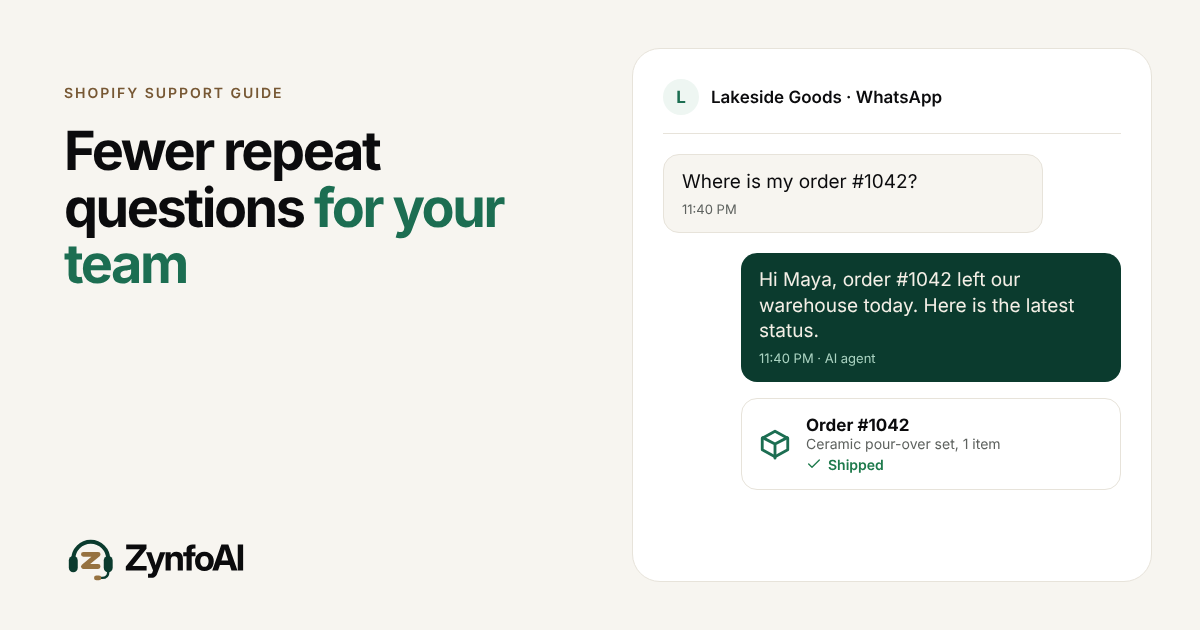
| Answer lives in your store data | ”Where is my order #1042?”, “Do you have this in blue?” | The AI agent, for online stores |
| Needs judgement | ”My parcel arrived broken and I want something different.” | Your team |
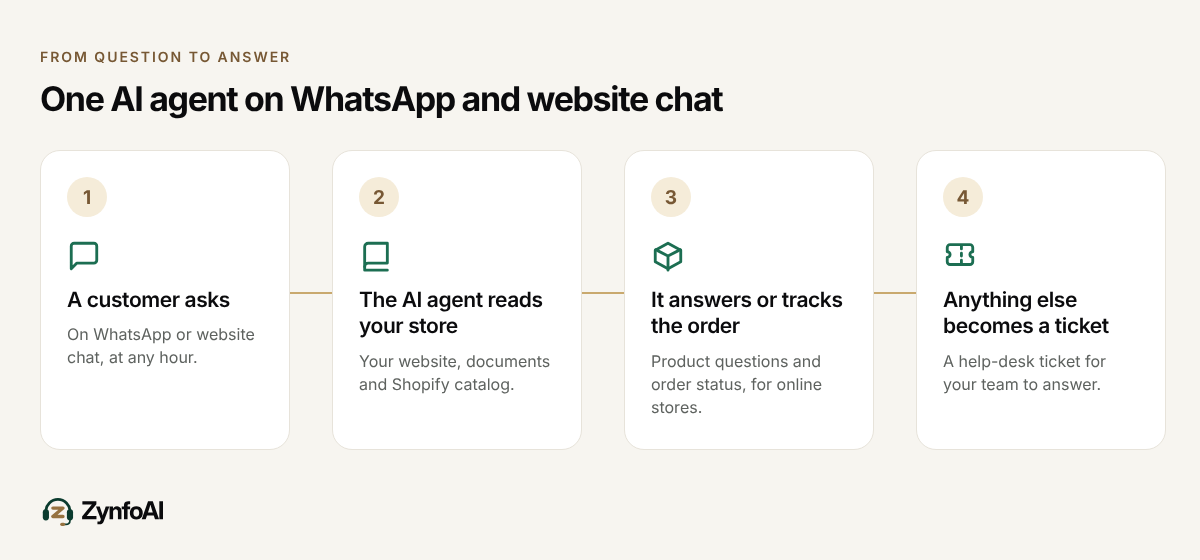
The first two piles are what change your workload. The third pile stays with people, and a good setup makes sure it reaches them with the question attached. In ZynfoAI, a question the AI agent cannot answer becomes a help-desk ticket for your team.
What do the tools charge when the AI does the work?
Most tools charge per outcome, so the bill rises with the AI’s success. Gorgias charges per automated interaction, Intercom’s Fin per resolution, Zendesk per automated resolution, and Tidio per Lyro conversation. ZynfoAI Starter is one flat monthly price with an allowance of 1,000 AI replies.
Here is the comparison, using each vendor’s own pricing page on 22 October 2026:
| Tool | Pricing model (from its own site) | Best for | Not for |
|---|---|---|---|
| Gorgias | Helpdesk plans from $10 a month; AI Agent add-on at $0.90 per automated interaction on an annual contract, $1.00 monthly | Shopify stores that want a full helpdesk and AI in one place | Teams that want a single flat price |
| Intercom Fin | $0.99 per resolution; $29 per Intercom helpdesk seat per month if you use Intercom’s helpdesk; 50 outcomes a month minimum on third-party helpdesks | Teams that already run another helpdesk and want to add an AI layer | Stores that want a predictable bill in a peak month |
| Zendesk | $1.50 per automated resolution when committed, $2.00 pay-as-you-go; Suite Team from $55 per agent per month billed yearly | Larger teams with complex, multi-channel operations | Small stores with two support people |
| Tidio Lyro | Lyro AI Agent from $32.50 a month for 50 conversations; the first 50 conversations are free (lifetime); higher tiers not shown on the page | Small stores that want to start cheap and grow | Stores that expect more than 1,000 AI conversations a month without a custom plan |
| ZynfoAI Starter | From $39/month, no per-resolution fees; 1,000 AI replies and 3 team seats; WhatsApp message fees billed by Meta | Small Shopify teams that want flat pricing on website chat and WhatsApp | Large enterprises that need a full ticketing suite, or stores above 1,000 AI replies a month |
Two cautions. Gorgias’s page also carries a second, higher set of plan prices in its page markup, so check the live page before you budget. And Tidio’s page does not list overage prices, so a bill above the tier you choose cannot be worked out from the page.
For the same maths across more tools, read flat price vs per-resolution AI pricing and the longer guide to evaluating AI customer support for Shopify.
What would Lakeside Goods pay in a Black Friday month?
Suppose the AI answers 800 conversations in November and each is billed as one outcome. At the published rates that is $792 on Fin, $800 on Gorgias’s monthly rate, $1,200 on Zendesk’s committed rate and $1,600 on pay-as-you-go. The 800 is an assumption, not a measurement.
| Tool | Rate used | 800 conversations | What the number leaves out |
|---|---|---|---|
| Intercom Fin | $0.99 per resolution | $792 | Seats if you use Intercom’s helpdesk |
| Gorgias | $1.00 per automated interaction, monthly contract | $800 | The helpdesk plan; each AI interaction also counts as a ticket |
| Zendesk | $1.50 committed, $2.00 pay-as-you-go | $1,200 to $1,600 | Per-agent Suite fees |
| ZynfoAI Starter | $39 flat | $39 | Anything above 1,000 AI replies |
Now the honest part for ZynfoAI. Starter includes 1,000 AI replies a month, and a conversation can take several replies. If a typical conversation at Lakeside Goods takes three replies (an assumption), 800 conversations would need 2,400 replies, more than Starter includes. So Starter fits a store whose AI-answered volume stays within 1,000 replies, and it does not fit a store sending thousands of conversations to the AI in one month.
The table also shows why a flat price matters in a peak month: the per-outcome bill moves with the AI’s success. The flat price stays $39 while volume sits inside the allowance. Support that scales. Your bill doesn’t, up to that allowance.
Why does the pricing model matter more than the headline price?
The pricing model decides who carries the risk of a busy month. Per-resolution pricing puts it on you: Black Friday traffic raises the bill the moment the AI does its job. Flat pricing puts it on the vendor, inside an allowance. Neither is wrong, but you should know which one you signed.
Ask each vendor three questions in writing:
- What counts as one billable unit: a ticket, a reply, a conversation or a resolution?
- Is there a minimum, such as Fin’s 50 outcomes a month on third-party helpdesks?
- What happens above the included amount: a higher rate, a forced upgrade or a paused AI?
Fin’s page, for example, defines one outcome per conversation even if the AI takes several actions. Gorgias’s page states $1.50 per interaction above the plan’s included allowance. Those are very different ways to hit a limit.
Black Friday planning has its own checklist in Black Friday customer support for Shopify.
Does the AI agent work where your customers write?
It has to, or the questions never reach it. ZynfoAI answers on a website chat widget and on WhatsApp Business through the official API, using one AI agent. The same agent reads your website, documents and Shopify catalog, so a shopper gets the same answer in both places. WhatsApp message fees are billed by Meta, not by ZynfoAI.
For a store in the US, UK, Canada, Australia or the UAE, the website widget is usually where the “where is my order?” message starts. For the order lookup itself, see the order tracking feature and the comparison of AI support tools for order lookup. Product questions come from the same catalog, covered on the product recommendations feature page.
What happens to the questions the AI cannot answer?
They must not disappear. A tool that stays silent on a hard question loses a customer, and a tool that guesses can cost more than it saves. ZynfoAI turns questions it cannot answer into help-desk tickets for your team, so each one is visible, countable and answered by a person.
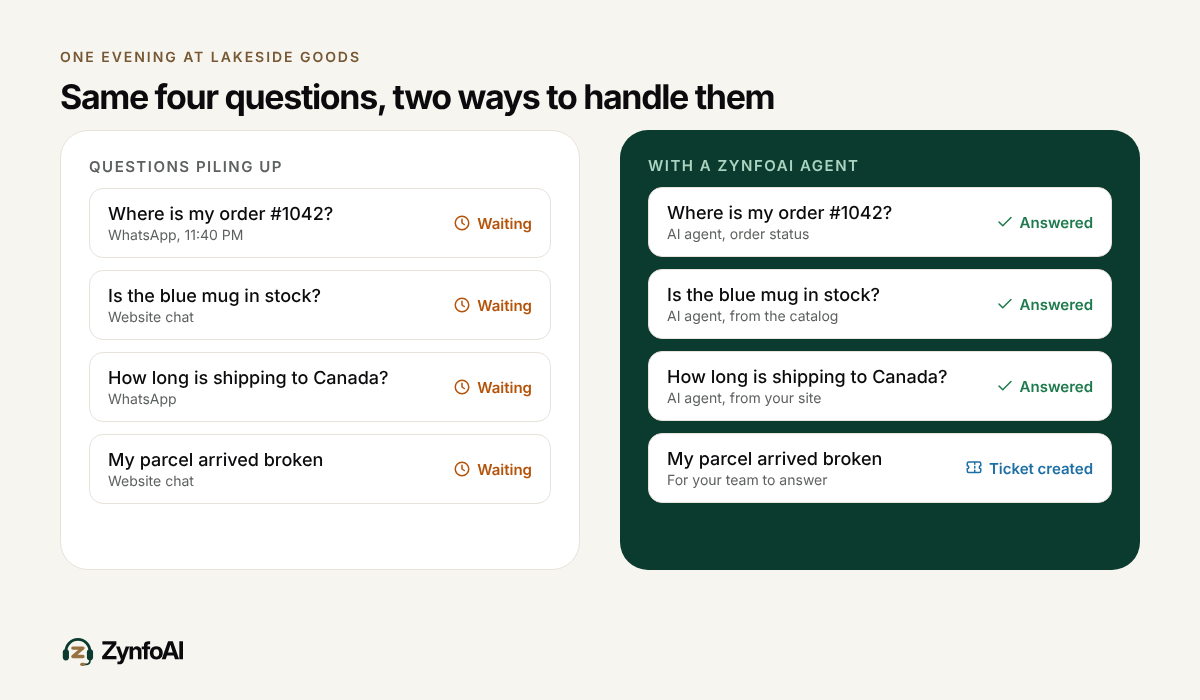
That ticket list is also your best planning data. After a month, the tickets show which answers are missing from your site. Add them to your documents and the next month’s list shrinks. This is the practical way to lower the load on your team: fix the content, not only the software.
If your queue is mostly shipping questions, reducing “where is my order” tickets on Shopify is the place to start.
How do you test whether it will help your team?
Run a two-week test on real messages before you change any hiring plan. A test measures your own store, which no vendor page can.
- Export or copy two weeks of real customer messages.
- Tag each: order status, product question, policy question, needs a person.
- Start the trial and connect your website and Shopify catalog.
- Ask the AI agent the first three kinds of question and read every answer.
- Count the answers you would have sent yourself, and the ones you would not.
- Check how many questions turned into tickets and why.
- Only then compare against your team’s hours.
You can also compare ZynfoAI directly with the tools above on our pages for Gorgias and Fin.
When is a different tool the better choice?
A different tool is better if you already run a full helpdesk with many agents, need complex workflows across email, voice and social channels, or expect far more than 1,000 AI replies a month. Zendesk and Gorgias price per agent or per ticket, which suits those larger setups.
ZynfoAI fits a smaller case: a Shopify store with a few people on support, customers who write on website chat and WhatsApp, and an owner who wants one flat monthly price. The pricing page shows the Starter plan, and the trial needs no card.
FAQ
What is the best AI customer support software to reduce support headcount?
It depends on your volume. Large teams in a full helpdesk often look at Gorgias, Intercom Fin or Zendesk. Small Shopify teams that want website chat and WhatsApp for one flat price can look at ZynfoAI. No tool can promise a headcount saving before it has read your store, so test on your own messages.
Will AI customer support replace my support team?
No. AI answers repetitive questions from your own content. Questions that need judgement still need a person. ZynfoAI turns questions it cannot answer into help-desk tickets for your team, so a person sees each one.
How much does ZynfoAI cost?
ZynfoAI costs from $39/month. Starter includes 1,000 AI replies a month and 3 team seats, with no per-resolution or per-seat fees. WhatsApp message fees are billed by Meta. There is a 7-day free trial with no card, and a 15-day money-back guarantee.
How do per-resolution AI prices compare in a busy month?
Per-resolution prices rise with volume. On the vendors’ own pages on 22 October 2026, Fin lists $0.99 per resolution, Gorgias $0.90 to $1.00 per automated interaction, and Zendesk $1.50 to $2.00 per automated resolution. At 800 AI-answered conversations that is roughly $792 to $1,600, before seats or helpdesk plans.
Does ZynfoAI work on WhatsApp and my website?
Yes. One AI agent answers on a website chat widget and on WhatsApp Business through the official API. It learns from your website, documents and Shopify catalog, with up to 50 knowledge sources. WhatsApp message fees are billed by Meta.
How do I try it?
Start the 7-day free trial at zynfo.ai. It needs no card, and you can cancel anytime.
Tools and guides
Put this into practice
AI Chatbot for E-commerce
Recover abandoned carts, automate order tracking, and boost online store sales.
Free ToolChatbot ROI Calculator
Calculate your projected cost savings, ticket deflection rate, and revenue impact.
Free ToolAI WhatsApp Reply Generator
Generate high-converting, professional WhatsApp sales and support replies with AI.
FeatureAI with Human Handoff
Escalate complex chats to live agents with complete conversation context.