AI Agents 13 min read
AI Agent vs Chatbot: What a Small Store Needs
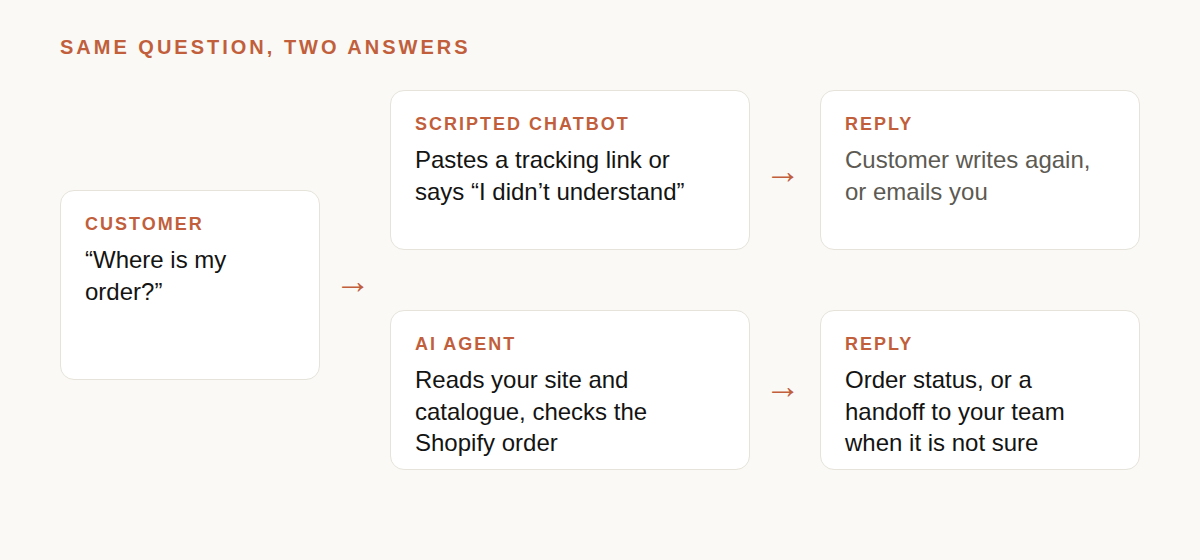
AI agent vs chatbot comes down to one question: does the tool only reply, or does it also look things up and do something? A chatbot follows a script and answers from a fixed list. An AI agent learns your own website and catalogue, checks a real order, saves a lead, and passes the chat to a person when it should. For a small store, that is the difference between “please email us” and “your order left Pune yesterday”.
Last updated: 6 October 2026
This guide is for owners who answer customers themselves, mostly on WhatsApp and the website chat. You will get a plain test to tell the two apart, a worked example from a Shopify store, a table you can lift into your own notes, and a checklist for choosing. It also says where an agent is not the right pick.
What is the difference between an AI agent and a chatbot?
A chatbot replies from a script or a fixed list of questions. An AI agent reads your own content, such as your website, documents and product catalogue, and uses it to answer in its own words. It can also check an order, save a lead, or pass the chat to your team. The chatbot talks. The agent talks and acts.
Other vendors draw the same line. Jotform’s comparison says agents are designed “to take action, not just respond”. Chatbot.com’s explainer describes agents as connecting to external tools and business systems, while chatbots mostly deliver text.
Words are used loosely, though. Many products sold as “AI chatbots” now read your content too. So don’t trust the label. Use the test in the next section.
How can I tell which one I am looking at?
Ask the vendor five questions. A chatbot answers “no” to most. An agent answers “yes” to most, and shows you.
- Does it learn from my website and files? Or do I type every answer in by hand?
- Can it check a real order? Not “send a tracking link”, but read the order and reply with its status.
- Does it save the customer’s details as a lead? With the name, phone number and what they asked about.
- Does it hand over to a person? With the conversation intact, so the customer doesn’t repeat themselves.
- Does it say “I don’t know”? Or does it guess?
Question five matters most. An agent that guesses on a return policy costs you more than a slow reply would have. Read how ZynfoAI trains on your data without making things up before you trust any tool with your policies.
What does a chatbot do well?
A scripted chatbot is good at one thing: a short, fixed menu. “Press 1 for store hours, press 2 for delivery.” If your customers ask three or four questions and the answers never change, that is enough.
Chatbots are also predictable. You wrote every reply, so you know exactly what a customer will see. That is a real advantage if you sell something regulated or sensitive, or if a wrong word could cost you.
The limits show up fast:
- Anything off the menu fails. “Do you deliver to my pin code in Jaipur?” gets “Sorry, I didn’t understand.”
- Every change is manual. New product, new return window, new festival offer: you edit each flow by hand.
- No order lookup. The bot can paste a tracking link, but it can’t see the order.
- Handoff is an afterthought. The customer is often asked to repeat the question to a person.
For many small stores these limits are exactly why the inbox fills up again by evening.
What can an AI agent do that a chatbot can’t?
An AI agent reads your content, answers questions it was never scripted for, and takes defined actions. In ZynfoAI’s case it learns from your website, uploaded documents and Shopify catalogue. On a Shopify store it can check order status, check refund status, recommend products and cancel an order that hasn’t shipped. It can also save a lead and hand over to a person.
Each of these maps to a question your customers already ask:
- “Where is my order?” The agent reads the order and replies. See order tracking.
- “Which one should I buy?” The agent recommends from your catalogue. See product recommendations.
- “Can I get a quote?” The agent collects the name, phone number and need, and saves them as a lead. See lead qualification.
- “I want to talk to someone.” The agent passes the chat to your team. See human handoff.
An agent is still a tool with limits. It only knows what you have given it. If your return policy is not on your site or in a document, it can’t invent one, and it shouldn’t. Part of setting it up is filling those gaps.
AI agent vs chatbot: how do they compare?
Here is the comparison in one place. The right-hand column describes ZynfoAI, an AI agent for your website and WhatsApp, so it is a fair picture of what the agent column means in practice, not of every product.
| Scripted chatbot | AI agent (ZynfoAI) | |
|---|---|---|
| How it answers | From a fixed script or list | From your own website, documents and catalogue |
| New question | Falls back to “I didn’t understand” | Answers from your content, or says it doesn’t know |
| Order status | Pastes a tracking link at best | Reads the Shopify order and replies |
| Leads | Often a form link | Saves details from the chat |
| Human handoff | Optional, often clumsy | Passes the chat to your team inbox |
| Setup effort | Build every flow by hand | Point it at your content, then test it |
| Best for | Three or four fixed questions | Varied questions plus order and lead tasks |
A worked example: a handloom saree store on Shopify
Take a small Shopify store that sells handloom sarees. Two people run it. Orders come from ads, but customers write on WhatsApp and the site chat.
On a normal evening, five messages arrive:
- “Do you ship to Dubai?”
- “Where is my order? I paid on Sunday.”
- “Is this saree dry-clean only?”
- “What is your return policy for a wrong size?”
- “I want to buy 12 sarees for a wedding. Can someone call me?”
A scripted chatbot handles number four if you wrote that flow. For number one it needs a shipping menu. For number two it sends a tracking link, if there is one. Number three is a product detail it was never given, so it fails. Number five gets a “contact us” message.
An AI agent that has read the shipping page, the product descriptions and the return policy answers one, three and four from them. For number two it checks the order in Shopify and replies with the status. For number five it collects the buyer’s name and phone number, saves the lead, and hands over to a person, because a 12-piece wedding order should get a human.
The owner opens the inbox the next morning to one conversation that needs them, not five. That is the realistic win. The agent doesn’t run the store. It clears the repeat questions and flags the sale.
Which one does a small store need?
Choose by the questions you actually get, not by the label. Count what your customers ask for one week, then match it.
- Mostly the same three or four questions? A scripted chatbot may be enough, and cheaper.
- Many different questions, a growing catalogue, and “where is my order” all day? You want an agent that reads your content and checks orders.
- Most sales happen on WhatsApp? Check that the tool uses the official WhatsApp Business API. Meta describes the WhatsApp Business Platform as the way for businesses to communicate with customers at scale. Our WhatsApp setup guide walks through it.
- Lead calls matter more than support? Look for lead capture first. See lead capture chatbots.
What does an AI agent cost compared with a chatbot?
ZynfoAI costs $99 a month flat, with no per-resolution fees. The plan includes 5,000 conversations a month and up to 11 team seats. You can start with a 7-day free trial from the site. Many tools charge per resolved conversation or per seat instead, so compare the monthly total at your own volume, not the headline price.
Scripted chatbots are often cheaper on paper, and some are free. That is fair when your needs are small. The cost question that matters is what happens when you grow. Our flat rate vs per-resolution pricing breakdown shows how to calculate it. You can see ZynfoAI’s plan on the pricing page.
Where does an AI agent still need a person?
An agent should never be the only thing between you and your customer. Hand over to your team for:
- A parcel marked delivered that never arrived. The customer is upset and needs a person’s judgement.
- A damaged or wrong item. Someone has to decide on the refund or replacement.
- A large or custom order. Like the wedding order above, this is where you earn the sale.
- Anything the agent doesn’t know. Better a handoff than a guess.
On WhatsApp, ZynfoAI’s agent pauses while a person handles the chat, so the two don’t talk over each other. Set your working hours and an offline message so customers know when to expect a reply. For rules on when to escalate, read our escalation guide.
This is also where what agentic AI really means is worth a look. “Agentic” does not mean “no humans”. It means the tool can complete small tasks, inside limits you set.
What should I check before choosing an AI agent?
Use this checklist when you compare tools. Tick each item with a demo or a trial, not a sales page.
- It learns from my website and documents, and I can see what it learned.
- It reads my Shopify catalogue and can check an order’s status.
- It works on my website chat and on WhatsApp Business through the official API.
- It saves a lead with the customer’s name and phone number.
- It says “I don’t know” and passes the chat to a person.
- The conversation goes to a shared inbox my team can see.
- I know the total monthly price at my volume, including seats and any per-resolution fees.
- I can test it before customers see it.
- I can try it free, and cancel when I want.
Run your own ten worst questions through any tool you test. Include one you know it can’t answer, and see what it does.
How do I start with an AI agent in one afternoon?
The steps are the same for most tools. This is how it works in ZynfoAI:
- Collect your content. Your website, return policy, shipping page and any product PDFs.
- Connect your sources. Add your website, upload documents, and connect your Shopify store.
- Test in the Playground. Ask the ten questions from the checklist above and fix gaps by adding content.
- Set handoff. Choose your working hours and the offline message.
- Go live on the website. Add the chat widget with one script tag.
- Add WhatsApp. Connect your WhatsApp Business account.
- Read the unanswered questions. Each week, add content for what it couldn’t answer.
Step seven is what separates a tool that gets better from one that sits there. The how it works page shows the setup in more detail.
FAQ
Is an AI agent the same as an AI chatbot?
Not quite. An AI chatbot replies to questions. An AI agent also uses your own content and can take defined actions, such as checking an order or saving a lead. Some products use the words loosely, so test what the tool does, not what it is called.
Is ChatGPT an AI agent for my store?
No. A general chat tool doesn’t know your catalogue, orders or return policy, and it can’t be placed on your WhatsApp number by itself. A store agent is trained on your own content and connected to your channels.
Can an AI agent replace my support team?
No. It answers the repeat questions and saves leads, and it hands over to your team for the cases that need judgement. Most small stores keep the same people and spend their time on the conversations that matter.
Do I need a developer to set one up?
Not for the basics. You add your website and documents, connect Shopify, test, and add one script tag to your site. The WhatsApp connection uses Meta’s official API through your WhatsApp Business account.
Does an AI agent work on WhatsApp?
Yes, if the tool supports WhatsApp Business through the official API. ZynfoAI answers customers on a website chat widget and on WhatsApp Business, and the conversations land in one team inbox.
How much does it cost?
ZynfoAI is $99 a month flat, with no per-resolution fees. It includes 5,000 conversations a month and up to 11 team seats. There is a 7-day free trial. See the pricing page.
The short version
If your customers ask the same few questions, a scripted chatbot is enough. If they ask many different questions and want real answers about their order, you want an AI agent that learns your business and hands over to a person when it should.
Start with the free trial and see how it handles your own questions. For a Shopify store, the webshop chatbot page is a good next stop, or read our Shopify AI chatbot guide.
Tools and guides
Put this into practice
AI WhatsApp Reply Generator
Generate high-converting, professional WhatsApp sales and support replies with AI.
SolutionWhatsApp AI Chatbot Platform
Automate customer support and sales over official WhatsApp Business API.
Free ToolWhatsApp Chat Widget Generator
Build a custom floating WhatsApp button to embed on WordPress or Shopify.
FeatureAI with Human Handoff
Escalate complex chats to live agents with complete conversation context.