AI Customer Support 16 min read
Best AI Customer Support Software for Ecommerce
The best AI customer support software for ecommerce is the one that reads the real order, recommends products from your own catalog, hands hard chats to a person, and charges in a way you can predict. Below, seven tools are compared on exactly those four things: Gorgias, Fin, Tidio, Zipchat, Richpanel, Zendesk and ZynfoAI. Every competitor fact comes from the vendor’s own page, opened on 16 October 2026, and each row links to it.
Last updated: 23 October 2026.
This post is for owners who answer customers themselves, or with one or two people, on WhatsApp, website chat and email. The same questions come all day: where is my order, do you ship to my city, can I return this. ZynfoAI is our product, so it is one row in the table, with an honest “best for” and an honest “not for”. Prices change often. Treat every number here as a snapshot and check the linked page before you buy.
Which AI customer support software is best for ecommerce?
No tool wins on every point. Pick by your size and your main channel: a helpdesk with AI added suits teams that live in email tickets, and an AI agent that answers in the chat suits small teams on WhatsApp and website chat. The table shows how seven tools differ on the four criteria buyers ask about most.
| Tool | Best for | Order tracking | Product recommendations | Human handoff | Pricing model |
|---|---|---|---|---|---|
| ZynfoAI | Small teams that want flat pricing on website chat and WhatsApp | Checks Shopify order status | Recommends products from your Shopify catalog | Unanswered questions become help-desk tickets; live chat handoff on the Pro plan | From $39/month, no per-resolution fees |
| Gorgias | Shopify brands that want a full ecommerce helpdesk | AI Agent covers “returns, order tracking, and more” | Shopping Assistant gives personalized recommendations, trained on your Shopify store | Described as working “without a human in the loop”; a human reply within 72 hours changes the billing | Helpdesk from $10 to $900 a month by ticket volume; AI Agent $0.90 to $1.00 per automated interaction |
| Fin | Teams that want to pay per outcome and keep their current helpdesk | Not described on the pricing page | Not described on the pricing page | ”Transfers to agents directly in preferred Inbox” | $0.99 per outcome, 50-outcome monthly minimum on another helpdesk |
| Tidio | Small shops that want live chat plus an AI agent at a low entry price | ”Native Shopify actions” on Growth and above; order tracking not named | ”Lyro product recommendation” with a paid Lyro quota | ”Human handoff” listed as a Lyro feature | Plans from $24.17 a month; Lyro AI from $32.50 a month for 50 conversations |
| Zipchat | Shopify stores that want an AI agent priced by replies | Can “pull real-time order data” | Recommends products from your catalog | Human escalation on every plan | From $64 a month (annual) for 750 AI replies; extra packs $49 per 250 |
| Richpanel | Stores that want a helpdesk with metered AI | AI handles “order and subscription updates”; self-service portal tracks orders | Not described on the pricing page | AI agents work with “human handoff” | Helpdesk $99 per seat a month (annual); AI about $0.20 per conversation, $200 monthly minimum |
| Zendesk | Larger teams already on Zendesk | Not described on the pricing page | Not described on the pricing page | Resolutions are billed only when completed “without any escalation to a human agent” | Suite Team $55 per agent a month (annual); AI resolutions $1.50 committed, $2.00 pay-as-you-go |
ZynfoAI is a good fit for small teams that want one flat price on website chat and WhatsApp. It is not for large enterprises that need a full ticketing suite with deep reporting and a long list of integrations. If that is you, a dedicated helpdesk such as Zendesk or Gorgias will serve you better.
“Not described on the pricing page” means the vendor’s page did not say. It does not mean the tool cannot do it. Ask the vendor, and ask for a demo on a real order from your own store.
What should an ecommerce AI support tool do?
A good tool does four jobs: it answers order questions from live data, recommends products from your catalog, passes the hard chats to a person, and keeps the bill predictable. Everything else is a bonus. If a tool fails one of the four, it will create work for you, not remove it.
Shopify’s own guide to AI chatbots for stores gives the same test. It says to confirm that a tool “pulls order status, shipping information, and inventory directly from Shopify”, not from a static file that can go out of date (Shopify, “AI Chatbot for Shopify: Tools Compared”). It also says a chatbot “should recognize when a conversation needs a real person”, for example a refund dispute, a damaged or lost order, or a frustrated shopper.
Use those two checks first. Then look at channels and price.
How does order tracking work in AI support software?
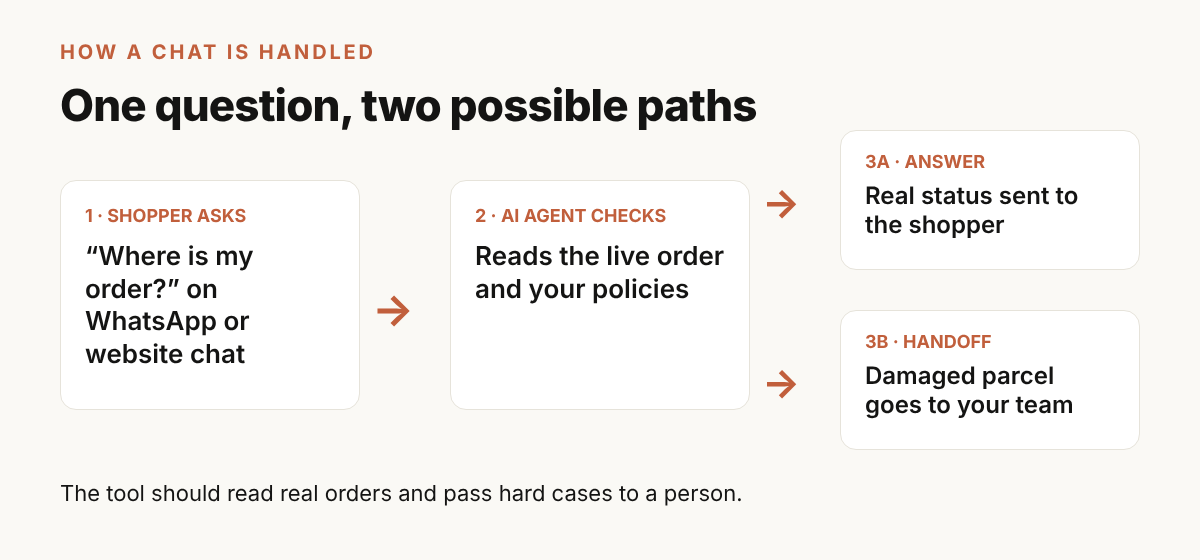
Order tracking means the tool reads the live order from your store and tells the shopper the real status in plain words. It does not quote your FAQ page. A tool that cannot see the order cannot answer “where is my parcel?”, which is the question that fills most small-store inboxes.
Shopify stores an order’s fulfilment state as a value such as unfulfilled, partially fulfilled, in progress, on hold or fulfilled (Shopify developer docs, OrderDisplayFulfillmentStatus, 2025-10 API version). A good tool turns those values into a sentence the shopper understands: “Your order has shipped”, or “Part of your order has shipped and the rest is being packed”.
Shoppers can also follow an order on Shopify’s own order status page after checkout (Shopify Help Center, order status page). An AI agent does not replace that page. It answers the shopper who asks in a chat instead of opening the page, and it works on WhatsApp, where many shoppers in India, the Gulf and the UK write first.
Here is what each vendor’s page says about orders today:
- ZynfoAI connects to Shopify. It can check order status and help shoppers find products in your catalog. See the order tracking feature.
- Gorgias says its AI Agent automates “returns, order tracking, and more” and lists Shopify among supported platforms.
- Zipchat says it can “pull real-time order data” and includes a Shopify integration on all plans.
- Richpanel says its AI agents handle order and subscription updates and that its Self-Service Portal lets customers track orders. The pricing page does not mention Shopify by name.
- Tidio lists “Native Shopify actions” from the Growth plan up, without saying which actions.
- Fin and Zendesk do not describe order tracking on the pricing page.
For a deeper comparison on this one job, read our post on the best Shopify AI support tools for order lookup.
Which tools recommend products inside the chat?
Product recommendation means the tool searches your catalog with the shopper’s own words and shows matching products, not a generic best-sellers list. This matters because many pre-sale questions are really “what should I buy?”, and an unanswered one is a lost sale.
Three vendors describe this on their own pages:
- Gorgias describes a Shopping Assistant that “delivers personalized recommendations that convert” and is “trained on your Shopify store and customer data”.
- Tidio lists “Lyro product recommendation”, available with a paid Lyro AI Agent quota of 50 to 1,000 conversations.
- Zipchat says it recommends products from your catalog based on what customers need.
ZynfoAI searches your live Shopify catalog with the shopper’s words and shows products as cards in the website widget, with a link to the product page. On WhatsApp the recommendation arrives as a message. See the product recommendations feature. Fin, Richpanel and Zendesk do not describe shopper product recommendations on their pricing pages.
A test worth running: ask “I need a gift under 1,500 rupees for my mother”. A good tool shows real products from your store that fit, or says it found none. A weak one invents a product.
How do these tools hand a chat to a human?
A good handoff passes the whole conversation to a person, so the shopper does not repeat themselves, and the AI stops replying once the person takes over. It should happen when a refund is large, a parcel arrives damaged, or the customer is upset or simply asks for a person.
Ask each vendor three questions:
- Which cases go to a person, and who sets the rule?
- Does the person see the full chat history?
- Does a handoff cost extra?
The answers differ more than you would expect. Fin says you are not charged “when a conversation is simply passed to your team without an outcome”, but a configured handoff Procedure is billed at $0.99. Zendesk bills only resolutions completed “without any escalation to a human agent”, so an escalated chat is not a billed resolution. Gorgias says an AI interaction is billed as a helpdesk ticket instead if a support agent replies within 72 hours of the AI resolution.
In ZynfoAI, live chat handoff is on the Pro plan: the chat moves to the shared team inbox, and on WhatsApp the AI pauses while a person handles the chat. On Starter, questions the AI agent cannot answer become help-desk tickets for your team. Read more on the human handoff feature page and in our guide to handoff and escalation.
What does AI customer support software cost for a small store?
The right pricing model is the one whose bill you can predict in your busiest month. Compare plans using your own volume, not the entry price on the page. Six models appear in this list, and each grows your bill in a different way.
| Model | Tools | What grows your bill |
|---|---|---|
| Flat monthly | ZynfoAI | Nothing, until the plan’s AI reply limit |
| Per outcome | Fin | Every outcome the vendor counts |
| Per automated interaction or resolution | Gorgias, Zendesk | Every conversation the AI settles |
| Per AI reply, in plan bundles | Zipchat | Replies, then extra reply packs |
| Per seat plus metered AI | Richpanel | Team size, then AI conversations |
| Monthly base plus conversation limits | Tidio | Billable conversations and Lyro conversations |
ZynfoAI costs from $39/month, with no per-resolution fees. Starter includes 1,000 AI replies a month and 3 team seats. Replies your team sends do not count toward the allowance. See the pricing page for what each plan includes.
Here is a made-up store to show the method. It is an example, not a customer story. A candle shop gets 1,000 order and policy chats in a Diwali month, and the AI takes about three replies to settle each one, so 3,000 AI replies.
| Tool | How the maths works | Rough monthly software cost |
|---|---|---|
| ZynfoAI | 3,000 replies is more than the 1,000 included on Starter, so this volume needs a bigger plan | Flat; see the pricing page |
| Fin | 1,000 chats at $0.99, if every chat counts as an outcome | $990 |
| Gorgias AI Agent | 1,000 interactions at $1.00 on monthly billing, before the helpdesk plan | $1,000 plus the helpdesk plan |
| Zipchat | 3,000 replies fits the Pro plan (3,000 replies) at $240 a month on annual billing | $240 |
Two cautions. “Outcome” and “automated interaction” are the vendors’ own definitions, so a real month may count fewer than 1,000 chats. And Tidio, Richpanel and Zendesk depend on seats, conversation counts or resolution allowances that vary with your setup, so we do not put one figure on them. Our post on flat rate versus resolution fees walks through the method in more detail.
Which channels does ecommerce support need?
Shoppers ask where they already chat. For many Indian, Gulf and UK stores that is WhatsApp first and website chat second. Check each tool’s channel list, and check that every channel lands in one inbox, so your team does not work in three tabs.
On the pricing pages: Tidio and Zipchat list WhatsApp among their included channels, Fin and Richpanel list WhatsApp as a supported channel, Zendesk lists WhatsApp with additional fees noted, and Gorgias lists email, live chat, voice and social channels but not WhatsApp. ZynfoAI answers on a website chat widget and on WhatsApp Business through the official API, with both landing in one shared inbox. On the Pro plan it also answers email.
WhatsApp message charges from Meta are separate from any support tool. Free-form service messages can be sent only while the 24-hour customer service window is open; after it closes, only pre-approved template messages are allowed (Meta, WhatsApp Cloud API send messages guide). Add Meta’s charges to your budget. Our guide to WhatsApp Business API pricing explains what changed on 1 October.
How do you test AI customer support software before paying?
Test with a real order from your own store and your own messages. A vendor demo uses a store with perfect pages. Your store has a half-shipped order, a typo in a phone number and a return page written two years ago.
- Place a test order on your store with two items.
- Ask “where is my order?” before it ships.
- Ship one item, then ask again. The answer should say part of the order has shipped.
- Ask about an order that does not exist. The tool should say it cannot find it, not invent a status.
- Ask for a product recommendation in your shopper’s words, such as a gift under a set budget.
- Ask a question your pages do not answer, such as a bulk price. It should hand over to a person, not guess.
- Write down the monthly price at double your normal volume.
- Repeat the test on WhatsApp if that is where your shoppers write.
Pass the tool only if it reads the real order, never invents a policy and shows a price you can plan around. For a wider buying list, read our guide on how to evaluate Shopify AI customer support, or the ecommerce chatbot guide.
When should you choose each tool?
Choose by your size and your main channel. These are simple rules, not rankings.
- Choose ZynfoAI if you are a small team, you want one flat price, and your shoppers write on website chat and WhatsApp. Do not choose it if you need a full enterprise ticketing suite.
- Choose Gorgias if you want a Shopify-focused helpdesk and are happy to pay by ticket volume.
- Choose Fin if you want to pay only when a conversation reaches an outcome and you already run a supported helpdesk.
- Choose Tidio if a low entry price, live chat and a pay-as-you-grow AI add-on matter most.
- Choose Zipchat if you want a Shopify-first agent with plans measured in AI replies.
- Choose Richpanel if you want a helpdesk with per-seat pricing and metered AI.
- Choose Zendesk if your team already runs on Zendesk and needs a full ticketing suite.
You can also read the alternatives page, the ZynfoAI comparison of ecommerce chatbots, and the WhatsApp and web chat comparison. All use the same rule: facts from the vendor’s own page, with a link.
Checklist: what to confirm before you choose
- The tool reads live orders from your store, shown on a test order.
- It tells a part-shipped order from a fully shipped one.
- It says “I cannot find that order” when it cannot, and does not guess.
- It recommends real products from your catalog, in your shopper’s words.
- A person can take over with the full chat, and the AI stops replying.
- You know what counts as a billable unit: outcome, interaction, reply, resolution or conversation.
- The monthly price at double your volume is written down.
- Every channel you use lands in one inbox.
- You know what you pay Meta for WhatsApp on top.
- You tested a question your pages do not answer.
FAQ
What is the best AI customer support software for ecommerce?
There is no single winner. Pick a tool that reads live orders, recommends products from your catalog, hands hard chats to a person and has pricing you can predict. ZynfoAI suits small teams that want flat pricing on website chat and WhatsApp. The other tools in the table suit different sizes and budgets.
How much does ZynfoAI cost?
ZynfoAI costs from $39/month, with no per-resolution fees. Starter includes 1,000 AI replies a month and 3 team seats. There is a 7-day free trial with every Pro feature on, no card needed, and a 15-day money-back guarantee on paid plans. See the pricing page.
Does ZynfoAI track Shopify orders?
Yes. ZynfoAI connects to Shopify, checks order status and helps shoppers find products. It answers on website chat and WhatsApp Business. Test it on a real order during the free trial.
What is the difference between per-resolution and flat pricing?
Per-resolution pricing charges for every conversation the AI settles, so the bill grows with your orders. Flat pricing charges one monthly fee up to a stated limit. Flat pricing is easier to plan around. Check the limit, and what happens when you reach it.
Can an AI agent hand a chat to a human?
Yes, if the tool supports it, and the details differ. Ask which cases go to a person, whether the person sees the full chat, and whether a handoff costs extra. In ZynfoAI, live chat handoff is on the Pro plan: the chat moves to a shared team inbox and the AI pauses on WhatsApp while a person answers. On Starter, unanswered questions become help-desk tickets.
How do I test a tool before paying?
Place a test order, ask where it is before and after it ships, and ask about an order that does not exist. Ask for a product recommendation and a question your pages do not answer. A good tool answers from live data and admits when it cannot. Start a free trial to run the test on your own store.
Tools and guides
Put this into practice
AI Chatbot for E-commerce
Recover abandoned carts, automate order tracking, and boost online store sales.
Free ToolChatbot ROI Calculator
Calculate your projected cost savings, ticket deflection rate, and revenue impact.
Free ToolAI WhatsApp Reply Generator
Generate high-converting, professional WhatsApp sales and support replies with AI.
FeatureAI with Human Handoff
Escalate complex chats to live agents with complete conversation context.