WhatsApp Automation 13 min read
WhatsApp Support for Beauty Brands on Shopify (India)
Last updated: 27 October 2026.
WhatsApp support for beauty brands is mostly the same twelve questions, asked at all hours: which shade, what is in it, is it safe to order, where is my parcel. If you run a skincare, makeup or haircare brand on Shopify in India, those messages arrive faster than a small team can type. This guide sorts the twelve by who should answer them, so an AI agent takes the ones a page or an order can answer and your team keeps the ones that need a person.
ZynfoAI is an AI customer service agent for Shopify stores that answers customers on WhatsApp Business and website chat. ZynfoAI Starter costs $39 a month, or $390 a year, with 1,000 AI replies a month and 3 team seats, no per-resolution or per-seat fees, and a 7-day free trial with no card.
What do shoppers ask a beauty brand on WhatsApp?
Shoppers ask about fit before they buy and about delivery after they buy. Before: shade, skin type, ingredients, how to use a product together with another, and whether a gift set is in stock. After: where the parcel is, cash on delivery, a leaking bottle, and when a refund lands. The before questions need your product pages. The after questions need your orders.
That split matters because beauty buyers cannot try the product. A shopper buying a foundation in Nagpur cannot hold it against her wrist, so she writes to you first. A shopper who has paid for a serum and sees no update writes to you again. Two kinds of message, two different sources of truth.
Here are the twelve, in the words customers type.
Which of the 12 beauty questions can an AI agent answer?
An AI agent can answer the questions whose answer already exists on your website, in your documents, in your Shopify catalog or in the customer’s Shopify order. Four questions need a person or a policy decision. The rest depend on how well your product pages are written.
ZynfoAI learns from your website, your documents and your Shopify catalog, and for online stores it reads the customer’s order to give a status. Anything it cannot answer becomes a help-desk ticket for your team.
| # | What the customer types | Where the answer lives | Who answers |
|---|---|---|---|
| 1 | ”Which shade of this foundation for medium wheatish skin?” | Product page shade chart and descriptions | AI agent, if the chart is written out in words |
| 2 | ”Is this serum good for oily skin?” | Product description, “who it is for” section | AI agent, repeating what you wrote |
| 3 | ”What are the ingredients?” | Ingredient list on the product page or a PDF | AI agent, quoting your list |
| 4 | ”I have sensitive skin. Will this suit me?” | Needs judgement about a person | Your team |
| 5 | ”What is the expiry or batch on my order?” | Usually printed on the pack, not in Shopify | Your team |
| 6 | ”Is this original?” | Your “about us” and sourcing page | AI agent, if the page states it |
| 7 | ”Can I use this with my vitamin C serum?” | Your usage guide | AI agent for what you wrote; your team for anything beyond it |
| 8 | ”Is the gift set in stock?” | Shopify catalog | AI agent |
| 9 | ”Where is my order?” | Shopify order and tracking | AI agent |
| 10 | ”Is cash on delivery available for my pincode?” | COD page | AI agent, if the page lists the rule |
| 11 | ”The bottle leaked in transit.” | A photo and a decision | Your team |
| 12 | ”When will my refund come?” | Refund policy page | AI agent for the policy; your team for a specific refund |
Seven of the twelve are answerable from material you already own or can write in an afternoon. Three stay with people. Two split. That is a mix to plan around, not a promise about what any store will see.
Why do beauty questions need a good knowledge base more than most categories?
Because beauty answers are specific and shoppers act on them. “Suits oily skin” and “suits dry skin” read the same to an AI agent unless the page says which. An agent can only repeat what your pages say, so vague product copy gives a vague reply, and clear copy gives a clear one.
Three habits make the difference:
- Write shade charts in words. A swatch image tells the agent nothing. A line like “Shade 03 Sand: medium skin with golden undertone” gives it something to say.
- List ingredients as text. Put the full list on the product page, or in a PDF or Word file that you add as a knowledge source. Shopify metafields let you add your own fields to products, which is one way to keep ingredients and usage steps in a tidy place (Shopify Help Center: metafields).
- Say who it is not for. “Not tested for use during pregnancy; ask your doctor” is a sentence an agent can repeat. A missing line is a gap a shopper will fill with a guess.
Our guide to the AI knowledge base for a Shopify store lists the twelve policy pages every Indian D2C store should write. This post adds the product-side pages a beauty brand needs on top.
Where should an AI agent stop and your team start?
Stop it wherever the answer depends on a person’s skin, health or a damaged parcel. Questions about sensitive skin, a reaction, pregnancy or a medical condition need a human reply, not a page. Write that rule into the agent’s instructions, test it, and let the question become a help-desk ticket.
This is the honest limit of any AI agent for a beauty brand. ZynfoAI answers from what you have given it. It does not examine skin, diagnose a reaction or decide a replacement. In the ZynfoAI dashboard you set the agent’s instructions and its message for questions it cannot answer, and the playground lets you try the awkward questions before customers do.
A sensible set of instructions for a beauty brand has three lines:
- Answer shade, ingredient and usage questions only from the product pages and documents.
- For skin conditions, allergies, pregnancy or any health question, say the team will reply and do not advise.
- For a damaged or leaking parcel, ask for the order number and say the team will respond.
On the Starter plan, a question the agent cannot answer becomes a help-desk ticket, and Starter does not transfer a live chat to a person. Live chat handoff to your team is on the Pro plan. For a beauty brand that wants a person to join a chat mid-conversation, that is the plan feature to know about. Our post on what happens when an AI agent cannot answer walks through both paths.
What does a beauty brand’s night on WhatsApp look like?
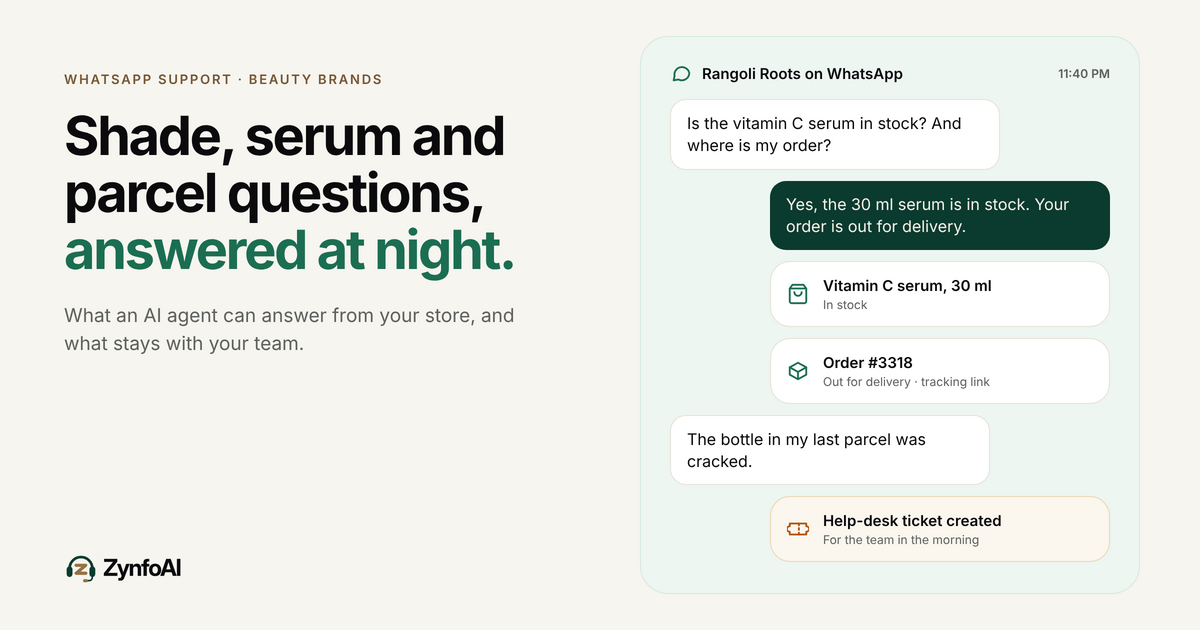
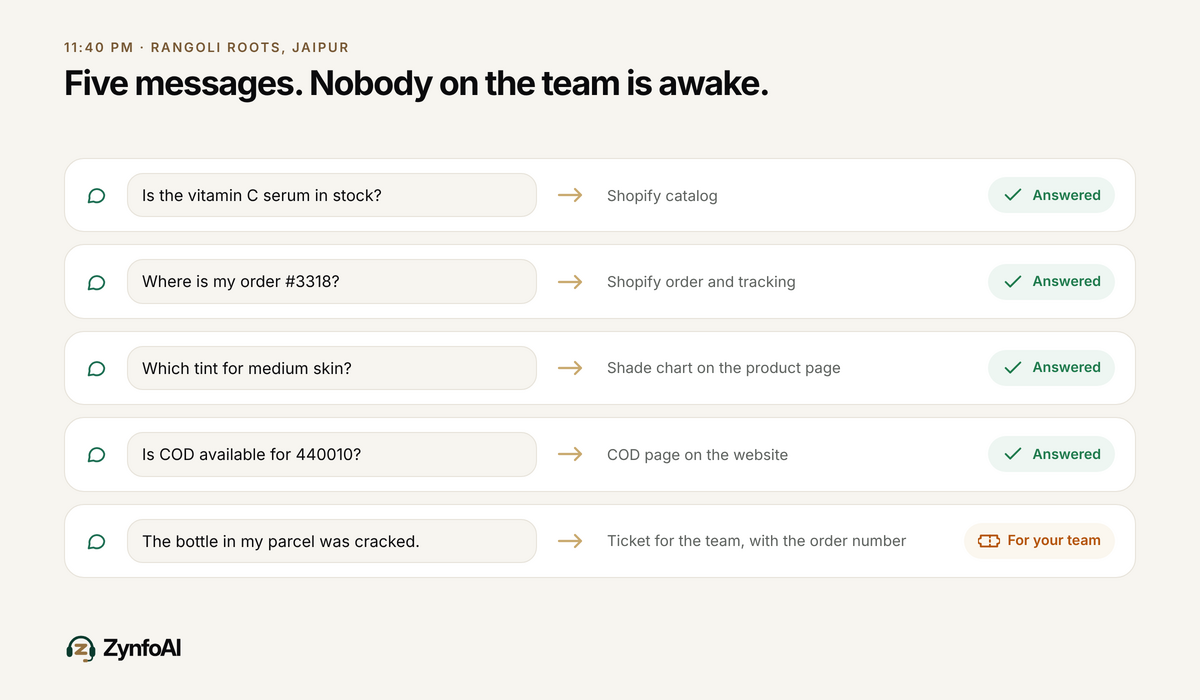
Take a made-up brand, Rangoli Roots, a Jaipur skincare and makeup label with a Shopify store. At 11:40 PM a shopper writes to ask whether a vitamin C serum is in stock and, in the same chat, where her last order is. A second shopper asks which tint suits her. A third reports a cracked bottle.
With ZynfoAI on the brand’s WhatsApp Business number:
- The stock question is answered from the Shopify catalog.
- The order question is answered from the Shopify order: a status and a tracking link. Shopify’s own order status page lets customers check shipment status once you add tracking numbers (Shopify Help Center: order status and tracking), and WhatsApp is where many Indian shoppers ask instead.
- The tint question is answered from the shade chart on the product page.
- The cracked bottle becomes a help-desk ticket with the customer’s details, ready for the team in the morning.
Nobody on the Rangoli Roots team is awake, and three of the four customers already have an answer. The fourth waits for a person, which is correct. The WhatsApp order tracking guide for Shopify covers the order half in detail, and the product recommendation feature explains how Shopify product search helps customers find products.
How does the flow work from question to answer?
A customer writes on WhatsApp or website chat. The AI agent reads your store’s pages, documents and catalog, and the customer’s order if there is one. If it has the answer, it replies. If it does not, it creates a help-desk ticket for your team so the question is not lost.
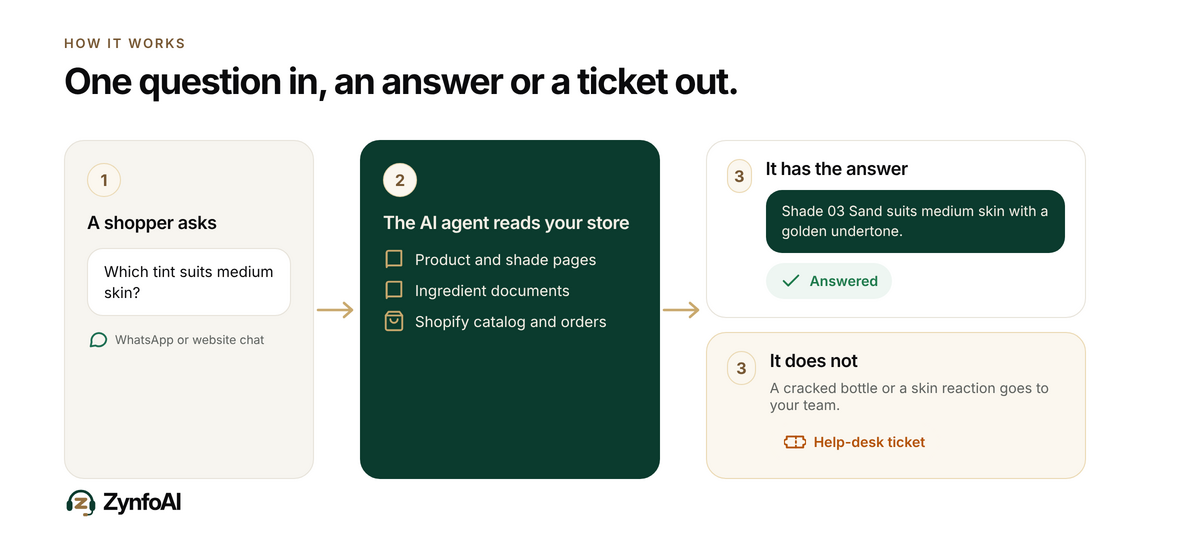
The same agent covers your website chat, so a shopper who starts on a product page and one who starts on WhatsApp get answers from the same source. That is the point of one AI agent on two channels: one set of pages to maintain, not two.
How many AI replies does a beauty brand need in a month?
Count conversations, multiply by the replies per conversation, and compare with your plan. As an assumption, not a measured figure, suppose a conversation takes about three AI replies. A brand with 280 WhatsApp conversations a month uses about 840 replies, inside Starter’s 1,000. A festive month of 450 conversations uses about 1,350.
| Month | Conversations (assumed) | AI replies at 3 per conversation | Fits Starter’s 1,000? |
|---|---|---|---|
| Normal | 280 | 840 | Yes |
| Festive sale | 450 | 1,350 | No: Pro has 5,000 |
At the limit, ZynfoAI’s AI replies pause until the monthly reset. Customers get a holding message and conversations still reach your team. Replies your team types do not count. If you expect a month like the festive one, choose Pro, which has 5,000 AI replies, or plan for the team to pick up the overflow. The guide to how many AI replies a Shopify store needs has a worksheet for your own numbers.
WhatsApp message fees are separate and billed by Meta. Meta says it does not charge for messages from users to businesses, and it gives every business phone number a free tier of 1,000 service messages a month, with charges from the 1,001st (Meta: WhatsApp Business Platform pricing). Check that page for the current rates before you plan your budget. ZynfoAI charges no per-resolution or per-seat fees on either plan, so the AI’s success does not raise your bill.
What about cash on delivery and festive rushes?
Cash on delivery is a question customers ask before buying, so it belongs in your knowledge base as a rule. State where COD is offered, any order value limit and any fee. The agent can then answer “is COD available for my pincode?” from your page, instead of your team answering it forty times a day. Our COD and RTO playbook covers the owner’s side of this.
ZynfoAI does not confirm COD orders. That call or message to the customer is a task for your own process.
The weeks before Diwali are when beauty gift sets sell and “will it reach by Dhanteras?” floods the inbox. Put your last-order date for festival delivery on a page, then follow the Diwali sale WhatsApp checklist. Diwali’s main day in 2026 is 8 November.
What should a beauty brand do this week?
Write the pages, load them, and test the twelve questions before you turn the agent on for customers.
- Write a shade chart in words for every product that has shades.
- Put every ingredient list on a page as text.
- Add “who it is for” and “who it is not for” lines to each product.
- Write your COD, shipping and refund rules, with your last-order date for festivals.
- Add the pages and your Shopify catalog as knowledge sources.
- Set the three instructions above for health questions and damaged parcels.
- Ask the agent all twelve questions in the playground and fix any weak reply by fixing the page.
- Start the free trial on your WhatsApp Business number.
If you are still choosing a tool, our comparison of WhatsApp tools for Shopify stores in India sets several side by side, and the pricing page lists exactly what each plan includes.
FAQ
Can an AI agent answer shade and ingredient questions for a beauty brand?
Yes, from what your store has written down. ZynfoAI learns from your website, your documents and your Shopify catalog, so it can repeat a shade chart or an ingredient list that is on a product page or in an uploaded file. It cannot judge a person’s skin.
Should an AI agent answer questions about sensitive skin or allergies?
No. Those questions need a person. Write an instruction that sends health and skin-condition questions to your team, test it in the playground, and let the question become a help-desk ticket. ZynfoAI answers from your pages and does not give medical or skin advice.
Does ZynfoAI work on WhatsApp for a Shopify beauty store?
Yes. ZynfoAI answers customers on WhatsApp Business through the official API and on website chat, and it works with Shopify. For online stores it reads the Shopify catalog and the customer’s order, so it can give an order status or help a shopper find a product.
How much does ZynfoAI cost for a small beauty brand?
ZynfoAI Starter costs $39 a month, or $390 a year, with 1,000 AI replies a month and 3 team seats. There are no per-resolution or per-seat fees, and WhatsApp message fees are billed by Meta. The 7-day free trial needs no card, and a 15-day money-back guarantee applies.
What happens when the AI agent cannot answer a customer?
It turns the question into a help-desk ticket for your team. Starter does not transfer a live chat to a person; live chat handoff is on the Pro plan. After the trial, the workspace moves to the Free plan with 100 AI replies a month unless you choose a plan, and your data is kept.
Tools and guides
Put this into practice
AI WhatsApp Reply Generator
Generate high-converting, professional WhatsApp sales and support replies with AI.
SolutionWhatsApp AI Chatbot Platform
Automate customer support and sales over official WhatsApp Business API.
Free ToolWhatsApp Chat Widget Generator
Build a custom floating WhatsApp button to embed on WordPress or Shopify.
FeatureAI with Human Handoff
Escalate complex chats to live agents with complete conversation context.