How Indian D2C Brands Reduce COD RTO with WhatsApp AI (2026) | ZynfoAI
Harmeet Singh
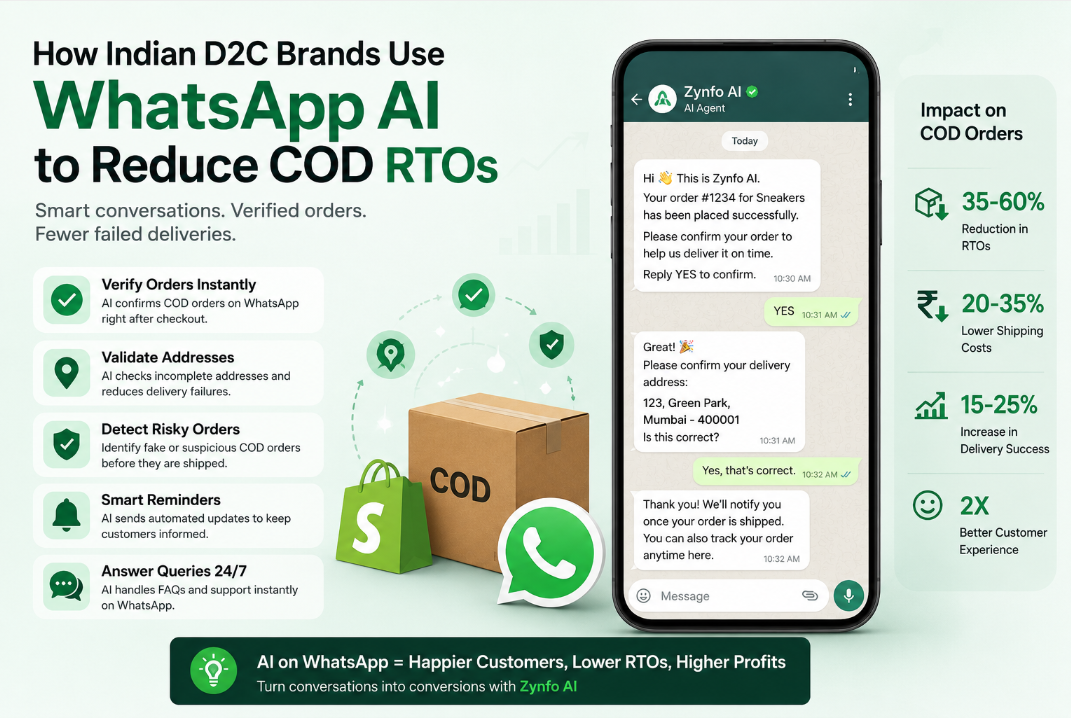
In this article
Share Knowledge
Cash on Delivery (COD) remains one of the most critical and popular payment methods in the Indian e-commerce landscape. Even as digital payments and UPI adoption skyrocket across the country, a significant percentage of consumers still fundamentally prefer to pay only after receiving the product in their hands. This preference is deeply rooted in consumer psychology, reflecting a desire to mitigate the risk of fraud and ensure product quality before parting with their hard-earned money.
While offering COD dramatically increases initial conversion rates for merchants, it simultaneously creates one of the most severe operational headaches for Direct-to-Consumer (D2C) brands: the dreaded RTO, or Return to Origin.
For rapidly growing Shopify brands in India, COD RTOs act as a silent assassin, steadily destroying profit margins. This phenomenon is driven by a myriad of factors including fake orders placed without true intent, unresponsive customers when the delivery agent arrives, notoriously complex and inconsistent address formats, flat-out delivery refusals, delayed order confirmations, and broader operational inefficiencies.
This is precisely where WhatsApp AI automation is emerging as an absolute game-changer. Many stores upgrading from legacy tools are seeking an autonomous BusinessOnBot alternative to handle conversational address correction and UPI incentives without rigid decision trees.
Modern, AI-powered WhatsApp agents are revolutionizing how brands handle post-purchase operations. They can automatically verify COD orders within seconds, confirm difficult addresses intelligently, detect risky buyers before a package is even dispatched, send highly contextual reminders, handle complex support queries effortlessly, and ultimately reduce failed deliveries at an unprecedented scale.
Indian D2C brands are aggressively moving toward this AI-driven WhatsApp automation. Why? Because Indian consumers practically live on WhatsApp. The response rates on the platform dwarf traditional email, the AI drastically reduces the manual workload placed on human support teams, and this proactive, automated customer engagement undeniably improves final delivery success. You can estimate your exact messaging costs with our free WhatsApp pricing calculator.
In this comprehensive guide, we’ll explore exactly how Indian e-commerce brands are leveraging WhatsApp AI chatbots to crush COD RTO rates, streamline their operations, and significantly bolster their profitability.
Table of Contents
- Introduction
- What is COD RTO in Ecommerce?
- Why COD RTOs Are a Massive Problem in India
- Traditional Methods to Reduce RTOs
- Why Traditional Approaches Fail
- How WhatsApp AI Changes the Game
- Key Ways WhatsApp AI Reduces COD RTOs
- Real Use Cases for Indian D2C Brands
- How AI + WhatsApp Works Behind the Scenes
- Shopify + WhatsApp AI Automation Workflow
- Best Practices for Indian Ecommerce Brands
- Common Mistakes Brands Make
- Metrics to Track
- Future of AI-Powered Ecommerce Support
- Final Thoughts
What is COD RTO in Ecommerce?
RTO stands for Return to Origin. In the context of e-commerce logistics, it refers to the scenario where a dispatched package fails to reach the end consumer and is consequently shipped back to the seller’s warehouse.
This typically happens under a few common circumstances:
- The customer outright refuses delivery when the courier arrives at their doorstep.
- The customer is entirely unreachable, ignoring calls from the delivery personnel.
- The delivery address provided is incorrect, incomplete, or impossible to locate.
- Delivery repeatedly fails over multiple attempts due to timing mismatches.
For e-commerce brands, a single RTO creates a cascading series of punitive costs. You lose money on the initial forward shipping, you pay again for reverse logistics to get the item back, you waste packaging materials, your valuable inventory gets delayed (and potentially damaged in transit), and you incur substantial operational handling and customer support costs trying to figure out what went wrong.
For Indian D2C brands that heavily depend on COD to drive volume, RTOs can swiftly become a massive margin killer. In specific high-impulse categories like fashion, beauty, health supplements, and electronic accessories, it is not uncommon to see RTO rates exceeding a staggering 25–40%.
Why COD RTOs Are a Massive Problem in India
India presents a deeply unique e-commerce environment compared to Western markets, making the RTO challenge particularly acute.
1. High COD Preference
Despite the digital payment revolution, a vast swathe of customers still deeply distrust prepaid online orders. Many prefer cash transactions out of habit, while others simply feel much safer utilizing COD, ensuring they only pay when they physically see the parcel. While this undeniably increases top-line conversions, it also inadvertently invites a high volume of low-intent purchases where the buyer experiences buyer’s remorse before the package even arrives.
2. Fake Orders
A surprising number of users place fake orders simply for fun, by accident, or without any serious intent to actually complete the purchase. Children playing with smartphones, competitors testing logistics, or impulsive late-night shopping that is regretted by morning all contribute to orders that will inevitably result in immediate RTOs.
3. Address Confusion
The structure of Indian addresses can be wildly inconsistent. It is common to see incomplete landmarks, severe spelling issues, apartment complex confusion, and vast regional language variations. Without rigorous pre-dispatch verification, these chaotic addresses guarantee that delivery failures will skyrocket as couriers struggle to locate the buyer.
4. Unreachable Customers
Many consumers are highly suspicious of unknown numbers and will routinely ignore calls from delivery agents. They might miss delivery attempts because they are at work, or they might frequently switch SIM cards. However, these very same customers are almost always reachable and highly responsive on WhatsApp, presenting a golden opportunity for brands.
Traditional Methods to Reduce RTOs
Before the advent of sophisticated AI automation, brands fought the RTO battle using highly manual, brute-force methods.
Many relied on expansive manual calling teams whose sole job was to ring up every single COD customer to confirm their intent. Others utilized basic SMS confirmations (which are frequently ignored), IVR (Interactive Voice Response) verification calls that feel incredibly robotic, and generic delivery reminder emails that inevitably land in the promotions folder.
Some rapidly scaling brands even found themselves forced to hire massive verification teams just to manually confirm COD orders before allowing them to be dispatched.
But this outdated approach creates severe operational bottlenecks. It demands expensive manpower, results in inconsistent follow-ups depending on agent performance, suffers from agonizingly slow response times, severely limits scalability during peak sale seasons, and is highly prone to human error. This is precisely why adopting a WhatsApp AI Chatbot is no longer a luxury, but a necessity.
Why Traditional Approaches Fail
The fundamental flaw with traditional support workflows is that they are entirely reactive. They only engage customers after a problem has already manifested—such as when a courier reports a failed delivery attempt.
Modern D2C brands require proactive systems that can intelligently identify risky orders at the moment of checkout, confirm genuine purchase intent early in the lifecycle, automate the mundane communication, and drastically reduce operational friction across the board. Manual workflows simply cannot scale efficiently or cost-effectively for fast-growing Shopify stores handling thousands of orders a month.
How WhatsApp AI Changes the Game
WhatsApp AI represents a paradigm shift by combining the power of conversational AI, complex automation workflows, deep e-commerce platform integrations, and real-time, highly personalized customer engagement.
Instead of waiting hours or days for human support teams to manually filter and contact buyers, AI agents act instantaneously. They can verify orders the second they are placed, empathetically answer customer concerns regarding shipping times or product details, seamlessly update malformed addresses via API, send perfectly timed dispatch reminders, and intelligently escalate highly suspicious or high-value risky orders to human managers.
This creates a frictionless, incredibly fast communication loop that significantly improves the final delivery success rate.
Stop Losing Money on COD RTOs
Automate your COD verification and drastically reduce return-to-origin rates with ZynfoAI's WhatsApp integration.
Key Ways WhatsApp AI Reduces COD RTOs
1. Instant COD Confirmation
Immediately after checkout, the AI agent can trigger a personalized message:
“Hi Rahul, your COD order for the Classic Black Sneakers has been successfully received! Please confirm your delivery by simply replying YES.” Customers who fail to respond to this simple prompt within a given timeframe can be automatically flagged in your system as risky. This one simple, automated step can reduce fake orders and low-intent purchases remarkably.
2. Address Verification
Advanced AI agents can parse addresses and automatically detect incomplete formats, missing critical landmarks, or invalid PIN codes. When an anomaly is detected, the AI can proactively ask:
“It looks like your address is missing a landmark. Please share a nearby landmark so our delivery partner can find you easily!” This preemptive intervention prevents countless failed delivery attempts later in the cycle.
3. Intelligent Risk Detection
By analyzing historical data, AI systems can identify repeat RTO offenders, highly suspicious ordering patterns (e.g., ordering the same item in 5 different sizes via COD), unusually high-value COD carts, and bulk fake purchases. Brands can then set up workflows to gently push these risky orders toward prepaid channels by offering a targeted discount, requesting partial upfront payment, or holding the order for manual review.
4. Automated Reminder Campaigns
Customers are busy and often simply forget that a COD delivery is arriving. A WhatsApp AI can send exciting dispatch updates, morning-of “out-for-delivery” reminders, and empathetic follow-ups if a delivery attempt fails. Keeping the customer highly engaged throughout the fulfillment process drastically increases their willingness to accept the package.
5. AI-Powered Customer Support
Post-purchase anxiety is a major driver of order cancellations. Customers frequently ask “Where is my order?”, “Can I change my delivery address?”, or “When exactly will the delivery happen?”. Without AI, human support teams get completely overwhelmed, leading to slow replies and frustrated customers canceling their orders. AI agents instantly resolve these repetitive queries, significantly reducing delays and maintaining the customer’s buying excitement. Learn more about how to train an AI agent to handle these specific support workflows.
Real Use Cases for Indian D2C Brands
Fashion Brands
Fashion brands are particularly susceptible to impulsive COD purchases, notoriously high return rates due to sizing issues, and outright fake orders. WhatsApp AI helps mitigate these issues by proactively confirming size selections, gently verifying the customer’s genuine intent, and systematically weeding out fake checkouts before expensive inventory is committed to a courier.
Beauty Brands
In the beauty sector, trust and education are paramount. Beauty brands leverage AI automation not just for transactional order reminders, but for delivering personalized product recommendations, skincare education, and highly accurate delivery tracking. When a customer feels informed and valued, trust increases, leading to higher acceptance rates and repeat purchases.
Supplement Brands
Health and fitness supplement brands frequently use WhatsApp AI to educate their buyers regarding dosage, answer complex nutritional product questions, and reduce any lingering hesitation before the delivery arrives. Customers who feel thoroughly informed and confident in their purchase decision are significantly less likely to refuse their COD orders.
How AI + WhatsApp Works Behind the Scenes
The architecture of a modern AI system involves deep integrations across multiple platforms. It seamlessly connects your e-commerce engine (like Shopify), the official WhatsApp Business API, your CRM, your internal knowledge bases (like Notion), and your order management/logistics systems.
The standard automated workflow looks exactly like this:
- Customer places a COD order on your storefront.
- Shopify triggers an immediate automation webhook containing the order payload.
- The AI agent instantly sends a highly contextual WhatsApp message to the buyer.
- The customer interacts, either confirming the order, updating their address, or asking a clarifying question.
- The AI interprets the intent and updates the CRM and order status accordingly (e.g., adding a “Verified” tag in Shopify).
- The fulfillment and delivery team receives only validated, high-intent information, allowing them to dispatch with confidence.
This creates a fully automated, watertight verification pipeline that operates 24/7.
Shopify + WhatsApp AI Automation Workflow
If you are running a Shopify store, implementing an AI workflow is incredibly straightforward.
Step 1: Order Creation
The customer places a COD order on your Shopify storefront. The checkout data is instantly captured.
Step 2: AI Verification Message
Within seconds, the AI sends a WhatsApp message containing an order confirmation, an estimated delivery date, and a polite request for the customer to validate their intent and address details.
Step 3: Customer Interaction
The customer receives the message and can easily reply to confirm the order, seamlessly request an address modification, or ask pressing support questions regarding the product they just bought.
Step 4: AI Decision Layer
The AI processes the interaction and intelligently categorizes the order into actionable buckets: verified and ready to ship, highly suspicious and requiring human review, or incomplete (awaiting address details).
Step 5: Fulfillment Optimization
Your warehouse only moves forward efficiently with validated orders. This surgical approach drastically reduces failed deliveries, lifts an enormous burden off your support team, and eliminates massive logistics waste.
Best Practices for Indian Ecommerce Brands
To maximize the effectiveness of your WhatsApp AI, you must cater to the specific nuances of the Indian consumer base.
Use Hinglish Conversations
Indian customers frequently communicate in a fluid mix of Hindi and English. An AI agent that strictly speaks in rigid, formal English will feel deeply alienating. If a customer asks, “Order kal tak aa jayega?”, an AI agent trained to understand and gracefully respond in Hinglish will perform significantly better than generic, out-of-the-box bots.
Keep Messages Human
Avoid robotic, sterile flows at all costs. Instead of forcing users to “Press 1 to confirm”, use natural, conversational phrasing:
“Hey Priya 👋 Just confirming your beautiful new dress for delivery tomorrow. Should we go ahead and dispatch it?” Natural, warm conversations dramatically improve engagement and response rates.
Verify High-Risk Orders
Not all orders are created equal. Extremely high-value COD orders should automatically trigger additional verification steps. The AI can offer lucrative prepaid conversion incentives (e.g., “Pay via UPI now for an extra 5% off!”) or seamlessly route the high-value order for a quick manual review by a senior agent.
Use Personalized Messaging
Always mention specific product names, accurate delivery dates, and the customer’s name. Personalization proves that you are a legitimate brand that cares, which inherently increases trust and the likelihood of the customer accepting the package.
Common Mistakes Brands Make
Over-Automation
The goal of AI is to assist, not to completely alienate the customer. Customers still desperately want a human escalation path when things get complicated. Ensure your AI can gracefully hand off the conversation to a human support agent when the user is frustrated or the query is too complex.
Generic Messaging
Copy-pasting basic automation templates feels incredibly spammy. Indian consumers are bombarded with promotional WhatsApp messages daily. They respond infinitely better to highly localized, deeply conversational, and genuinely helpful experiences.
Ignoring Analytics
Implementation is only step one. Brands must rigorously track their analytics. If you aren’t monitoring your confirmation rates, tracking the overall RTO reduction, analyzing WhatsApp response rates, and measuring delivery success metrics, you are flying blind. Continuous optimization is key.
Metrics to Track
To truly understand the ROI of your WhatsApp AI implementation, closely monitor these key performance indicators:
- COD Confirmation Rate: What percentage of users reply “Yes” to the initial prompt?
- WhatsApp Response Rate: How deeply are customers engaging with the channel?
- Overall RTO Percentage: The ultimate metric—is the total percentage dropping?
- Failed Delivery Reduction: Are couriers finding addresses easier?
- Support Ticket Reduction: Has the volume of “Where is my order” queries dropped?
- Repeat Purchase Rate: Are satisfied customers coming back for more?
- Customer Satisfaction Score (CSAT): Are users rating the automated experience highly?
Tracking these vital metrics allows you to tweak and optimize your AI workflows continuously for maximum impact.
Future of AI-Powered Ecommerce Support
The future of Indian e-commerce will undeniably become increasingly, if not entirely, conversational. The impact of AI in customer support is expanding daily.
AI agents are rapidly evolving from simple, rule-based automation tools into highly intelligent commerce assistants. In the very near future, AI systems will seamlessly predict delivery risks before an order is placed, hyper-personalize communication based on deep behavioral data, autonomously automate highly relevant upsells, and manage the entire customer journey end-to-end.
WhatsApp will remain the central hub for this revolution because India is a profoundly mobile-first economy, customers inherently trust the messaging platforms they use to talk to their families, and the conversational commerce paradigm is growing at an explosive rate.
Final Thoughts
COD RTOs represent one of the biggest, most damaging hidden costs in the Indian e-commerce ecosystem. Continuing to rely on manual verification systems is incredibly expensive, highly error-prone, and virtually impossible to scale during massive sales events.
WhatsApp AI provides a drastically smarter, faster, and more efficient alternative. By intelligently automating order confirmations, dramatically improving the quality of customer communication, proactively filtering out fake orders, and heavily increasing overall delivery success, it directly impacts the bottom line.
For ambitious Indian Shopify brands, implementing conversational AI is no longer an optional shiny feature. It is quickly becoming a fundamental competitive advantage.
Brands that aggressively adopt and optimize AI-powered WhatsApp workflows early will vastly improve their profit margins, reduce crippling operational chaos, and create significantly better, more modern customer experiences. As Indian e-commerce continues its meteoric growth, intelligent automation will indisputably define the next generation of D2C success.
Transform Your D2C Support Operations
Connect Shopify and WhatsApp with ZynfoAI to automate verification, slash RTO rates, and scale your business effortlessly.
Related Keywords & Expertise
Recommended Resources & Tools
Put this into practice with our free tools & solutions
AI WhatsApp Reply Generator
Generate high-converting, professional WhatsApp sales and support replies with AI.
WhatsApp AI Chatbot Platform
Automate customer support and sales over official WhatsApp Business API.
WhatsApp Chat Widget Generator
Build a custom floating WhatsApp button to embed on WordPress or Shopify.
AI with Human Handoff
Escalate complex chats to live agents with complete conversation context.
You Might Also Like
How AI Agents Are Transforming E-commerce
Discover how autonomous ecommerce AI agents transform retail. Learn high-impact use cases, customer support automation, and growth strategies.

Best AI Chatbot for Ecommerce (2026 Guide) | ZynfoAI
Discover the best AI chatbot for e-commerce. Automate order tracking, reduce cart abandonment, and increase AOV by 23% with ZynfoAI's 24/7 retail AI agent.
AI Chatbots for Online Food Ordering & Restaurants
Learn how an AI Chatbot for Online Food Ordering can transform your restaurant by automating orders, reducing wait times, and boosting customer satisfaction.
Want to learn more?
Explore our entire library of insights on AI automation, lead generation, and scaling customer support.
Read blogs nowAutomate your support with AI
Deploy an AI agent in 2 minutes. Deflect 70%+ of customer tickets.