Best AI Customer Support Chatbots 2026: Founder's Guide
Sachin Jaiswal
In this article
Share Knowledge
If you are a SaaS founder navigating the complexities of scaling your business in 2026, you already know that customer support is a double-edged sword. On one hand, exceptional support acts as a powerful growth lever that builds trust and retains users. On the other hand, as your user base expands, support rapidly transforms into a suffocating growth tax that drains your team’s energy and your company’s profit margins.
To overcome this, you need an automated solution that delivers three specific outcomes: fewer repetitive tickets without sacrificing user trust, lightning-fast answers that help prospects convert, and a robust infrastructure that will not collapse under the weight of enterprise cliffs, message caps, or confusing credit add-ons.
This comprehensive guide compares five of the most popular automation options on the market—Tidio, Chatbase, tawk.to, SiteGPT, and AiSensy—providing you with a straightforward framework to choose the right platform based on how your SaaS actually grows. Furthermore, if your ultimate objective is driving signups rather than merely lowering ticket volume, we will explore exactly what you should look for in a specialized ai chatbot saas like ZynfoAI to truly eliminate your customer support headache.
What “Good” Looks Like for SaaS Support Automation
Before diving into specific tool comparisons, it is critical to establish a baseline for what makes an AI support system truly effective. Many founders make the mistake of purchasing flashy tools that fail to execute fundamental tasks, ultimately resulting in paying for a chatbot while human agents still answer the exact same repetitive tickets.
The MVP Requirements (Do Not Buy Without These)
Any platform you consider must handle the absolute basics with unwavering reliability. First, the system must seamlessly train on your real, dynamic knowledge sources, including website content, help center documentation, and PDFs. Utilizing the best ai knowledge base tools ensures that your AI agent is operating on accurate, up-to-date company data.
Secondly, the chatbot must provide highly accurate answers that natively link back to relevant documentation for further reading. It must also feature a frictionless human handoff protocol that never traps a frustrated user in an endless automated loop.
Finally, your chosen tool must excel at chatbot lead generation by capturing critical contact details—such as email addresses or meeting links—and routing those leads appropriately. Robust analytics that track deflection rates, pinpoint top user intents, and identify unanswered questions are also non-negotiable for continuous optimization.
The Scaling Requirements (Where Tools Diverge)
While many chatbots can handle the MVP basics, the true separation between platforms occurs when your company begins to scale. This is where you must scrutinize advanced capabilities like automated workflows that allow the bot to process refunds, cancel subscriptions, upgrade accounts, or reset passwords without human intervention.
You must also evaluate the depth of their integrations. Does the platform connect natively with essential SaaS infrastructure like Stripe, Zendesk, major CRMs, and product analytics suites? Additionally, consider whether the tool offers genuine multi-channel deployment across your website, email, social media, and messaging apps. Lastly, you must carefully navigate complex pricing mechanics, watching out for hidden credit systems, strict message caps, and steep “enterprise cliffs” that severely penalize your growth.
Deep Dive: The 5 Competitors What SaaS Founders Should Know
To make the best decision for your startup, you need a clear, founder-friendly understanding of how the leading chatbots for saas platforms stack up against one another in real-world scenarios.
1. Tidio
Positioning: A comprehensive customer support platform blending live chat, multichannel inbox management, and AI automation.
Why Founders Pick It: Tidio is highly favored for its exceptionally quick setup process and its broad array of customer-communication features. It provides an “all-in-one” feel that is highly appealing to teams looking for a unified dashboard to manage multiple support streams simultaneously.
Founder Watchouts: The primary risk with Tidio lies in its pricing structure as you scale. You must carefully model your projected monthly conversation volume early on to avoid severe tier shock as your traffic grows. Additionally, you need to rigorously test and confirm that the platform supports the exact escalation and agent routing workflows your team requires.
2. Chatbase
Positioning: A dedicated platform for building custom AI support agents that you can deploy via a simple web widget and gradually expand using actions and integrations.
Why Founders Pick It: Chatbase offers a highly transparent tier structure built around a clear credit system. Their higher-tier plans prominently feature advanced technical capabilities, including robust API access, custom integrations, and specialized automated actions that appeal to highly technical teams.
Founder Watchouts: While transparent, credit-based pricing models can be incredibly difficult to forecast accurately, especially during sudden traffic spikes or viral marketing events. Furthermore, many critical scaling features are heavily gated behind higher pricing tiers, meaning you must meticulously map out your long-term needs before committing to the platform.
3. tawk.to
Positioning: A massively popular, entirely free live chat platform that offers optional, monetized add-ons and premium services for teams that require them.
Why Founders Pick It: tawk.to remains the ultimate “start now” option for early-stage founders operating on tight budgets. It is incredibly useful if your primary objective is simply providing human-to-human support chat with zero upfront software costs.
Founder Watchouts: The platform’s capabilities are largely manual by default. If your main Key Performance Indicator (KPI) is automated AI resolution or ticket deflection, you will inevitably need to purchase premium add-ons or seek out a dedicated AI layer to achieve true automation at scale.
4. SiteGPT
Positioning: Marketed effectively as “ChatGPT for your product,” this platform focuses entirely on providing a site-trained support agent that answers questions based directly on your URL.
Why Founders Pick It: SiteGPT wins on its incredibly simple mental model: you simply scrape your website to train the bot, embed the widget, and immediately begin deflecting repetitive inquiries. It offers straightforward deployment with highly predictable, tiered scaling.
Founder Watchouts: Founders must pay close attention to rigid message limits and how their specific choice of underlying AI models impacts their overall credit usage. Additionally, it is crucial to confirm exactly which pricing tier includes the specific third-party integrations and complex workflows your SaaS will eventually require.
5. AiSensy
Positioning: A specialized WhatsApp marketing and automation platform built directly on the official WhatsApp Business API ecosystem.
Why Founders Pick It: AiSensy is purpose-built and highly optimized for businesses that utilize WhatsApp as their absolute primary communication, support, and sales channel. It is a powerhouse for international conversational commerce.
Founder Watchouts: For US-based SaaS companies, or teams where support and pre-sales motions are primarily handled via web widgets, in-app messaging, or traditional email, adopting a heavily WhatsApp-first tool can create a massive channel mismatch and frustrate your core user base.
The Pricing Reality Check (Where Founders Get Surprised)
When evaluating software, the initial price tag rarely reflects the true cost of operating the tool at scale. Across all of the platforms mentioned above, founders consistently underestimate several hidden costs that rapidly inflate their monthly software expenditure.
First, message and credit growth almost always outpaces initial estimates; if the chatbot works well and users engage with it, your consumption will skyrocket. Second, many platforms charge surprisingly high premium fees simply to remove their “Powered by” branding from the widget. Third, team access limits often force companies onto expensive enterprise plans just to give their support staff necessary login credentials. Finally, the “enterprise cliff”—the massive financial jump from a standard professional tier to an enterprise tier to unlock crucial integrations—frequently catches growing startups completely off guard.
A Practical Approach to Software Selection
To avoid these financial traps, take a highly practical approach to your evaluation. Forecast your combined monthly conversations for both support and pre-sales. Identify your top ten most frequent user intents. Decide exactly which three automated actions matter the most to your operations (such as cancel, upgrade, or reset password). Only after mapping these requirements should you begin comparing pricing tiers.
Use this quick decision framework to guide your choice:
- If you need free live chat immediately, start your journey with tawk.to.
- If you need an AI agent with advanced actions and can manage credit usage, evaluate Chatbase.
- If you require a comprehensive helpdesk and multichannel inbox, consider Tidio.
- If you want website-trained answers instantly, test out SiteGPT.
- If you need WhatsApp as a primary communication channel, evaluate AiSensy.
If Your Goal is Signups, You Need Support Plus Conversion
Here is the critical piece of the puzzle that most comparison blogs entirely skip: a lot of tools optimize strictly for ticket deflection, but SaaS founders ultimately need tangible revenue outcomes.
Your chatbot should not just act as a digital shield for your support team. It must actively convert high-intent visitors who are asking critical pre-sales questions like, “Does this integrate with Salesforce?” or “How fast can my team onboard?” The system must intelligently route hot leads to the appropriate motion, seamlessly discerning between users who are ready for self-serve checkout and enterprise prospects who require a high-touch sales assist. Furthermore, it must secure 24/7 automated lead capture, guaranteeing that you capture demand even when your entire human team is offline.
That is precisely why your support agent must be built and optimized like a comprehensive growth system. It requires accurate answers drawn from a robust knowledge base, remarkably clean escalation pathways to human agents, prominent conversion-focused CTAs, and deep analytics that tie chat interactions directly back to successful user signups.
The Fastest Way to Validate Any AI Support Tool
Do not waste a month running a sluggish “maybe” trial. Instead, run a tightly controlled, two-hour pilot program.
First, install the widget on a staging version of your marketing site. Second, train the AI exclusively on your pricing page, your core onboarding documentation, your top ten help articles, and your cancellation policies. Third, stress-test the system by asking it ten highly complex questions pulled directly from your real-world support tickets and recent sales calls.
Finally, measure the results objectively. Track the correct answer rate, the average time it takes to trigger a human handoff, the overall lead capture rate, and the number of demo or trial clicks generated directly from the chat interface. If the platform cannot decisively win this constrained two-hour pilot, it will absolutely not win in a live production environment.
Where ZynfoAI Fits: Reducing Headaches While Increasing Signups
If you are a SaaS founder and your primary KPI is to dramatically reduce your customer support headache while simultaneously keeping your sales pipeline moving, ZynfoAI is engineered specifically for that mission.
While other platforms force you to choose between simple deflection or complex marketing automation, ZynfoAI bridges the gap, providing highly intelligent conversational ai sales san francisco grade technology tailored for scaling software companies. It delivers on the promise of deploying AI agents that genuinely reduce your operational burden without sacrificing the personalized touch that closes deals.
Do not wait a month to decide while your support queue continues to overflow and hot leads bounce from your pricing page. Install the platform quickly, train it instantly on your existing documentation, and start permanently deflecting repetitive questions this week.
Ready to Deploy Your Autonomous AI Agent?
Train an AI agent on your website and documents in 5 minutes. Deliver instant, hallucination-free answers across Web and WhatsApp.
Ready to finally reduce your support headache and transform your customer interactions into a predictable growth engine? Start your 7-day free trial of ZynfoAI today and experience measurable deflection, faster answers, and a cleaner human handoff within your very first week.
Related Keywords & Expertise
Recommended Resources & Tools
Put this into practice with our free tools & solutions
AI with Human Handoff
Escalate complex chats to live agents with complete conversation context.
Chatbot ROI Calculator
Calculate your projected cost savings, ticket deflection rate, and revenue impact.
Shared Team Inbox
Manage website chat, WhatsApp, and email conversations from a unified workspace.
AI FAQ Generator
Turn documents, manuals, and URLs into structured FAQs and schema markup.
You Might Also Like
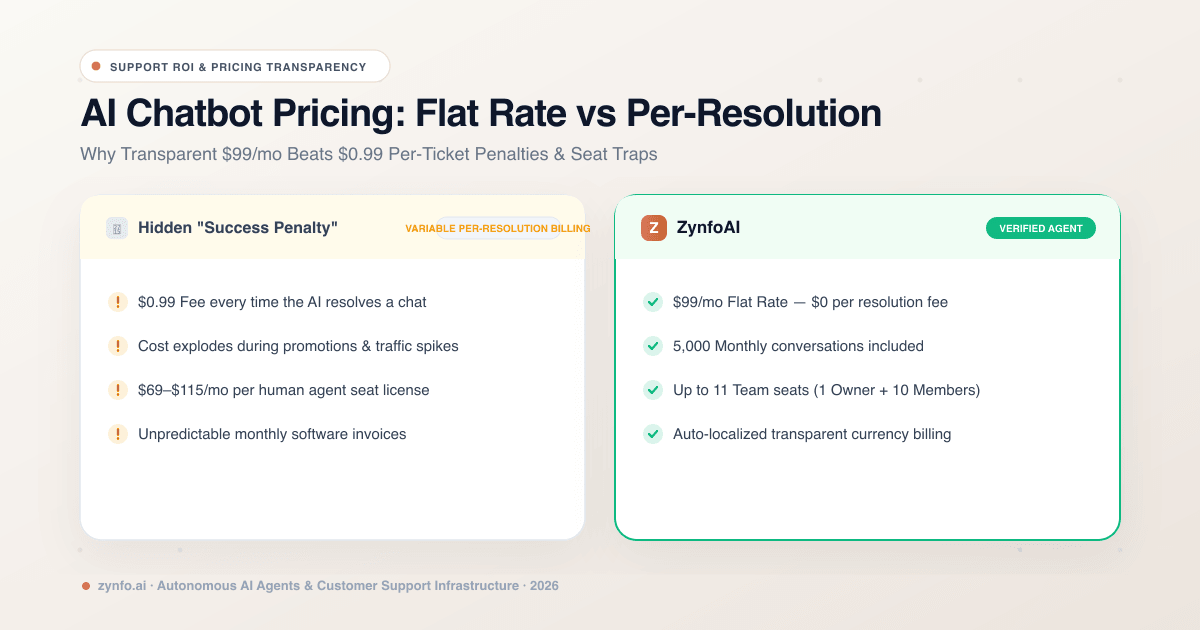
AI Chatbot Pricing Breakdown (2026): Flat-Rate vs Per-Resolution Fees & True Support ROI
Understand how AI chatbot pricing works in 2026. Compare flat monthly plans vs per-resolution fees ($0.99/ticket penalties), seat licenses, and calculate real support ROI.
ZynfoAI vs Ada: Pricing & Enterprise AI Agent Comparison 2026
Compare ZynfoAI vs Ada on enterprise scalability, pricing model, setup time, and agentic AI workflows. Discover why scaling brands prefer a value-based AI Agent.
ZynfoAI vs Crisp: Pricing & Features Comparison 2026
Compare ZynfoAI vs Crisp Chat on workspace limits, AI agent accuracy, RAG capabilities, and pricing. See why companies are upgrading to agentic automation.
Want to learn more?
Explore our entire library of insights on AI automation, lead generation, and scaling customer support.
Read blogs nowAutomate your support with AI
Deploy an AI agent in 2 minutes. Deflect 70%+ of customer tickets.