AI Agents 5 min read
The Future of Websites: AI Agents That Finish the Task

Most people don’t visit your website to browse it. They come with a job: check if you ship to their city, find the right size, see what the plan costs, book a call. The site’s menus and pages are the route they have to take to get it done.
AI agents change the route. The visitor types what they want, and the agent answers, looks it up or does it, right there in the chat. The website doesn’t disappear. It becomes the source the agent reads from, plus the pages people still want to see.
This post covers what that shift looks like in practice, what it doesn’t change, and where a growing business should start. If you’re new to the term, start with what agentic AI is.
Every extra step loses someone
Friction on websites is well documented. Baymard Institute’s checkout research, drawn from 50 studies, puts the average documented cart abandonment rate at 70.22%. Among the reasons shoppers give, 17% say the checkout was too long or complicated and 18% say the site wanted them to create an account (Baymard Institute: cart abandonment rate).
Those numbers are about checkout, but the pattern holds across a site. A visitor who has to find the shipping page, then the returns page, then the contact form, has three chances to give up.
What an agent does differently
Take a visitor who wants to know if a jacket fits and whether it’ll arrive by Friday.
The click route: open the product page, find the size chart, go to the shipping page, work out the delivery zone, then look for a contact form to ask about the rest.
The agent route: “Will the medium fit someone 180 cm tall, and can it get to Leeds by Friday?” The agent reads your size chart and shipping page, answers both questions, links the sources, and shows the product card.
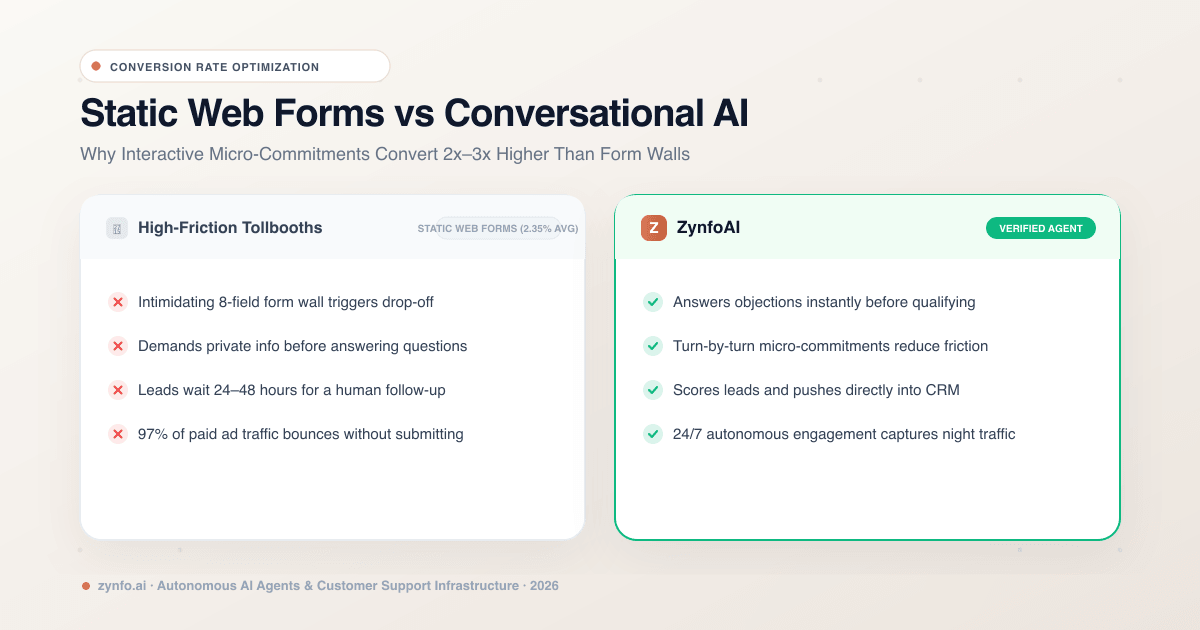
| Feature | Zynfo AI | Menus and forms |
|---|---|---|
| How the visitor starts | Says what they want | Picks a menu item |
| Finding an answer | The agent reads your pages for them | They read your pages |
| Doing the task | Order lookup, lead capture or a ticket in the chat | A separate page or form |
| What you learn | The question in their own words | Clicks and bounce rates |
That last row is underrated. Every chat tells you, in the customer’s words, what your website failed to make obvious.
What doesn’t change
It’s easy to overstate this. Three things stay as they are.
Your pages still matter, more than before. The agent can only answer from what’s written down. Clear pricing, shipping and policy pages are now the agent’s source material as well as reading for visitors.
Search still sends people to pages. Google’s own guidance says there are no extra requirements or special optimisations to appear in its AI Overviews and AI Mode; the usual advice on helpful content and technical basics still applies (Google Search Central: AI features and your website).
Some visitors want to browse. People comparing sofas want photos, so the agent is a shortcut alongside your pages.
Where a growing business should start
Start where the questions repeat and the answers are already written down.
- Put an agent on your website that answers from your content. Shipping, returns, pricing, opening hours. A website chat widget is the usual starting point.
- Give it one or two tasks. For a store, order lookups. For a service business or SaaS, capturing a lead with the details your sales team needs; our lead capture chatbot guide covers how.
- Answer where your customers already message you. In many markets that’s WhatsApp, which businesses reach through Meta’s Cloud API (WhatsApp Cloud API docs). ZynfoAI connects through Meta’s Embedded Signup.
- Keep a person one step away. Anything the agent can’t answer, or shouldn’t decide, becomes a help-desk ticket for your team, with the conversation attached. Live chat handoff is on the Pro plan.
The website becomes the agent’s source
The likely future isn’t a homepage replaced by a chat box. It’s a website with two audiences: people who read it, and agents that read it on their behalf. Both need the same thing: clear, current, specific pages.
If you write your returns policy so a person can’t misread it, an agent won’t either. That’s the most practical thing you can do this month.
Topics
Tools and guides
Put this into practice
Chatbots vs Static Forms
Replace static contact forms with conversational AI flows that qualify leads as they chat.
Free ToolChatbot ROI Calculator
Calculate your projected cost savings, ticket deflection rate, and revenue impact.
Free ToolFree Schema Markup Generator
Create valid JSON-LD structured data for Google rich snippets in seconds.
FeatureShared Team Inbox
Manage website chat and WhatsApp conversations from one workspace.