AI Agents 12 min read
AI Agent for a Local Service Business: A Practical Guide
An AI agent for a local service business answers the repeat questions customers send on WhatsApp and your website, using your own pages and documents, then passes the job to you when a person is needed. It does not fix the washing machine or clean the flat. It handles “Do you come to my area?”, “What do you charge for a visit?” and “Can someone call me?” so you stop typing the same replies between jobs.
Last updated: 8 October 2026.
This guide is for owners of electronics repair shops, home repair and home cleaning companies, small clinics and studios who answer customers themselves, often from a phone while on a job. You will see which questions an AI agent can take, which ones must stay with you, a worked example, a setup list and a short FAQ. ZynfoAI is our product, so we say plainly where it fits and where it does not.
What is an AI agent for a local service business?
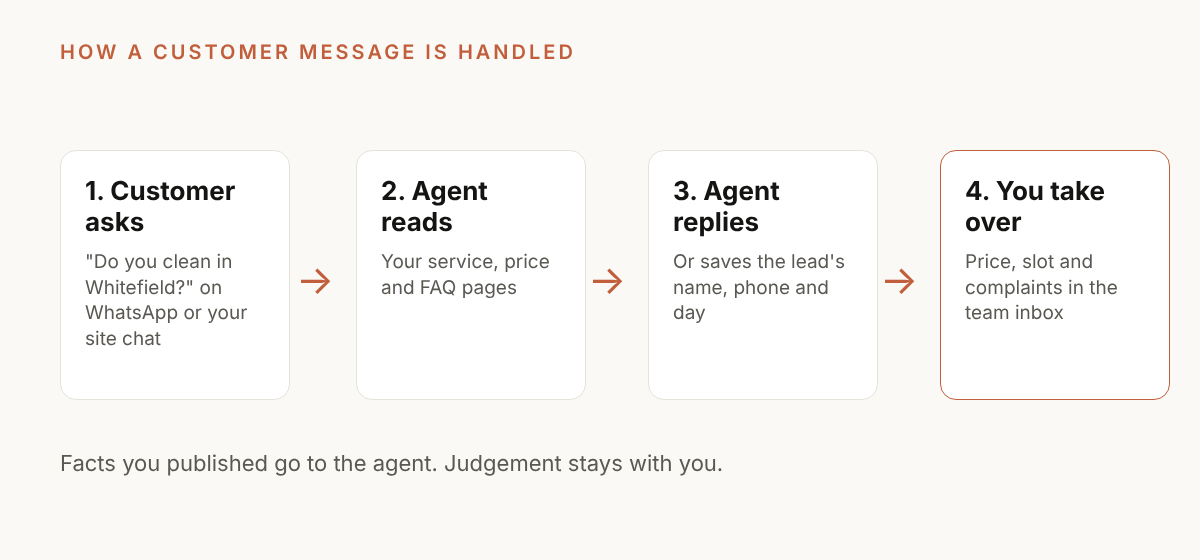
An AI agent is software that reads your own website and documents, then answers customers in your words on WhatsApp and a website chat. It can save a lead’s details and hand the chat to a person. A basic chatbot follows fixed buttons. An agent answers from what you published and knows when to stop.
If you want the longer comparison, read our post on AI agent vs chatbot. For a service business the short version is this: a customer writes in their own words, and the agent finds the answer in your service list, your price page and your policy page. If the answer is not there, it says so and brings in a person instead of guessing.
It is worth saying what an agent is not. It is not a replacement for the technician, the cleaner or the doctor. It is the person at the front desk who knows every page of your website by heart and never gets tired of the same question.
Which customer questions can an AI agent answer for you?
An AI agent can answer any question whose answer already sits on your website or in a document you give it: services offered, areas covered, working hours, visit charges you have published, how a booking works and your policies. It cannot answer what you have never written down.
Here is how that sorts out for a typical repair or cleaning business:
| Customer asks | Can the agent answer? | Where the answer comes from |
|---|---|---|
| ”Which areas do you cover?” | Yes | Your service area page |
| ”What are your timings on Sunday?” | Yes | Your contact or hours page |
| ”Do you repair this brand?” | Yes, if you list brands | Your services page |
| ”What does a visit cost?” | Yes, if the price is published | Your price list or FAQ |
| ”My fridge is leaking, can someone come today?” | Collects the details, then hands to you | A person decides the slot |
| ”Can you do it for less?” | No, hands to you | A person decides the price |
| ”The cleaner damaged my sofa.” | No, hands to you | A person handles the complaint |
The pattern is simple. Facts you have already published go to the agent. Judgement, price changes and complaints go to you.
This also shows you what to fix first. If you cannot point to a page that answers the question, the agent cannot either. Many local business sites show only a phone number or a WhatsApp link and nothing else. An agent is only as good as what you give it to read.
How does an AI agent work on WhatsApp for a repair or cleaning shop?
The agent connects to your WhatsApp Business number through the official WhatsApp Business API. A customer messages that number, the agent reads the message, looks up the answer in your content and replies. When a person should step in, the chat moves to your team inbox and the agent stops replying to that customer.
Meta, the company behind WhatsApp, describes the platform as a way to run automated conversational flows for high volumes of inbound support requests, with chats passed to a human agent only when needed. The technical rules sit in Meta’s Cloud API documentation: you need the customer’s opt-in before you send template messages, and templates need approval before use.
For you as the owner, three practical points follow:
- Use the official API, not a workaround. A number connected through the official route is the safer base for a business that depends on WhatsApp.
- Replying is different from sending campaigns. The agent replies to people who wrote to you. Sending first messages needs approved templates and opt-in, which is a separate job.
- Check what Meta charges. Meta’s own message charges depend on country and message type. Our guide to WhatsApp Business API pricing in 2026 explains what to ask any vendor.
If you want the WhatsApp side in more detail, see how to automate WhatsApp replies with AI and our page on the WhatsApp AI agent.
What does it look like in a real week? A worked example
Take a made-up home cleaning company with three cleaners and one owner, Meera. Every evening she gets about the same set of messages. We use “about” on purpose: this is an illustration, not a measured result from a customer.
Before an AI agent, a Tuesday evening looks like this. At 8 pm a customer asks if she cleans in Whitefield. At 9 pm another asks the price of a two-bedroom deep clean. At 10 pm a third asks if the team brings its own equipment. Meera is tired, the phone is on the table, and she answers in the morning. By then one of them has booked someone else.
With an AI agent trained on her website, her price page and a one-page FAQ she wrote, the same evening goes differently:
- The Whitefield question is answered from her service area page.
- The price question is answered from her published price list. If she did not publish a price for that flat size, the agent says a person will confirm and passes the chat on.
- The equipment question is answered from her FAQ.
- For a customer who wants a slot, the agent asks for name, phone number, address area and preferred day using an in-chat form, saves it as a lead, and tells the customer that the team will confirm.
- Meera sees the saved lead and the full chat in the morning, in one shared inbox, and calls the customer.
The agent did not book a cleaner or promise a time. It kept the lead warm and gave Meera everything she needed to close it.
What should the AI agent never do in a service business?
An AI agent should not quote a price you have not published, promise a visit time, give safety advice, or settle a complaint. It should say a person will follow up and hand the chat over. Your name is on the job, so decisions that cost money or carry risk stay with you.
Write these rules down before you switch it on:
- No invented prices. If a price is not on your site or in your documents, the answer is “our team will confirm”.
- No promised times. The agent collects the preferred day. You confirm the slot.
- No advice on gas, electrical or medical matters. Send these straight to a person.
- Complaints go to a human at once. Anyone who sounds upset should reach you, not a script.
Our guide to human handoff and escalation lists the situations worth handing off, and the human handoff feature shows how the shared team inbox works.
How do you set up an AI agent for a local service business?
Setup is five steps: write down your answers, point the agent at them, test it with real questions, connect WhatsApp and your website, and decide your handoff rule. Most of the work is in the first step, because the agent can only be as clear as the pages you give it.
- Write the ten questions you answer most. Open your WhatsApp and list what customers actually ask. Put each answer on your website or in a document.
- Give the agent your pages. ZynfoAI learns from your website, documents and, for online sellers, a Shopify catalog.
- Test with real messages. Paste in last week’s customer questions in the Playground and read every reply. Fix the page, not the agent, when an answer is wrong.
- Connect WhatsApp Business and the website chat. Both channels run from one place, so you see every conversation together.
- Set the handoff rule. Decide which topics go to a person, and who in your team sees them first.
Plan for one afternoon of writing answers and a week of watching the first conversations. After that, read the questions the agent could not answer and add those answers to your site. That list is also a free to-do list for your website.
Why does your website matter for an AI agent?
Your website decides how good the agent is. It also decides whether customers can find you. Google Business Profile lets a verified business add a WhatsApp or text messaging option where chat is available in their region, so a customer can reach you straight from search. Whatever they find there, the answer needs a page to come from.
Many local business sites have a phone number, a WhatsApp link and nothing else. Add a services page, an areas page, a price or “what affects the price” page, and a short FAQ. Those four pages answer most messages. They also help customers who never message you at all.
Is an AI agent worth the money for a small service business?
It is worth it when you lose jobs or evenings to repeat questions. ZynfoAI costs $99 a month flat, with 5,000 conversations a month and up to 11 team seats included, and no per-resolution fees. Meta’s own WhatsApp charges are separate. Check the pricing page for the current plan.
A simple test: count how many messages you answer on WhatsApp in a week that ask for facts already on your site. Multiply by how long each reply takes you. If that time is worth more to you than the plan, an agent pays for itself in time. If you get five messages a week, you do not need one yet.
You can try it without paying first. There is a 7-day free trial with full access, and a 15-day money-back guarantee after you pay. You can cancel anytime. Start from the pricing page or read how lead capture with an AI agent works.
Who is this not for?
An AI agent is not the right fit if you need a full ticketing and field-dispatch system, if almost all your customers call instead of writing, or if you have no written answers to give it yet. In that last case, write the answers first. That work helps you whether or not you ever use an agent.
For small teams that answer on WhatsApp and a website chat, the fit is good. You can see how it applies to your trade on our services industry page, or look at the lead qualification feature if getting booking requests matters most.
A checklist before you switch it on
- I have a services page, an areas page and a price or “what affects the price” page.
- I have written my top ten customer questions and their answers.
- I know which topics always go to a person.
- I have tested the agent with last week’s real messages.
- My WhatsApp Business number is connected through the official API.
- I know who in my team sees a handed-over chat first.
- I have checked Meta’s message charges for my country.
Frequently asked questions
Can an AI agent book a repair or cleaning visit for me? It can collect the customer’s name, phone number and preferred day in a form and save the lead. Your team confirms the slot. It does not read your calendar.
Will it make up prices? It answers from your pages and documents. If a price is not there, set the rule that it says a person will confirm and hands the chat over.
Does it work on WhatsApp and my website? Yes. ZynfoAI answers on a website chat widget and on WhatsApp Business through the official API.
What happens when a customer wants a person? The chat goes to a shared team inbox, and your team takes over with the full conversation in front of them.
How long is the free trial? 7 days with full access. After paying, there is a 15-day money-back guarantee, and you can cancel anytime.
Do I need to be technical? No. You add your website and documents, test the answers, and connect WhatsApp and your website chat.
Tools and guides
Put this into practice
AI WhatsApp Reply Generator
Generate high-converting, professional WhatsApp sales and support replies with AI.
SolutionWhatsApp AI Chatbot Platform
Automate customer support and sales over official WhatsApp Business API.
Free ToolWhatsApp Chat Widget Generator
Build a custom floating WhatsApp button to embed on WordPress or Shopify.
FeatureAI with Human Handoff
Escalate complex chats to live agents with complete conversation context.