How to Train an AI Agent on Shopify, Notion & WhatsApp | ZynfoAI
Harmeet Singh
In this article
Share Knowledge
E-commerce support is changing faster than ever. Customers now expect instant replies, accurate order updates, personalized recommendations, and 24/7 help—especially on conversational channels like WhatsApp. This shift in consumer behavior means that traditional customer service models, which rely heavily on human agents manually checking systems, are no longer sufficient to scale efficiently.
That’s exactly where AI agents come in.
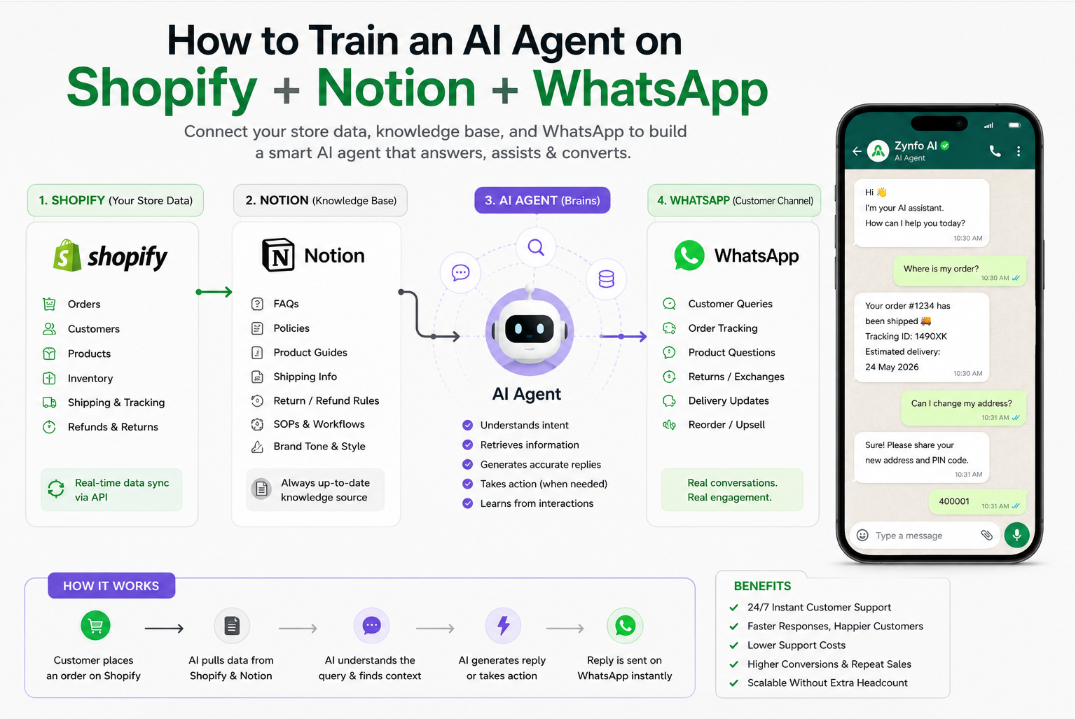
Unlike a basic “FAQ bot” that only understands specific keywords, a modern AI chatbot for e-commerce is designed to understand intent (even in messy, real-world messages), pull live information from Shopify (such as orders, shipping, and inventory), search your internal documentation in Notion (policies, SOPs, FAQs), and respond naturally directly in WhatsApp.
In this comprehensive guide, you’ll learn a simple, practical, and highly effective workflow to train an AI agent using Shopify, Notion, and WhatsApp—a technology stack that’s especially powerful for Direct-to-Consumer (D2C) and e-commerce brands looking to scale without proportionally increasing their headcount.
Table of Contents
- What is an AI Agent (in plain English)?
- Why Ecommerce Brands Need AI Agents
- Why Shopify + Notion + WhatsApp Works So Well
- The Data Your AI Agent Needs
- A Step-by-Step Training Workflow
- Using Shopify Data (Orders, Products, Inventory)
- Using Notion as Your Knowledge Base
- WhatsApp Integration (What it enables)
- Designing Conversational Flows
- Handling Real Customer Questions (Examples)
- RAG vs Traditional Chatbots
- Common Challenges (and how to avoid them)
- Best Practices for Training AI Agents
- What’s Next for AI Commerce Agents
- Final Thoughts
What is an AI Agent (in plain English)?
Think of an AI agent as a highly intelligent, 24/7 support teammate who never sleeps and has perfect memory of your store’s policies.
A traditional chatbot usually follows rigid, pre-defined decision trees. It breaks the moment a customer asks something unexpected or complex. It typically struggles with dynamic inquiries like “Where is my order?” because it lacks the ability to fetch real-time tracking information from your store’s database.
An Agentic AI or modern AI agent is fundamentally different. It combines multiple advanced capabilities:
- A Large Language Model (LLM) to understand nuance, intent, and write natural responses.
- Retrieval systems to pull the exact right policy or Standard Operating Procedure (SOP) from your Notion knowledge base.
- Real-time integrations to fetch live order status, inventory levels, and customer details directly from Shopify.
- Memory and context to keep a conversation consistent over multiple messages, remembering what the user said earlier.
The result is a support system that provides more accurate answers, requires fewer human escalations, and delivers a dramatically better customer experience.
Why Ecommerce Brands Need AI Agents
As your e-commerce sales grow, your support volume inevitably grows alongside it. However, hiring more customer support representatives doesn’t always scale gracefully. Training takes time, human error is inevitable, and maintaining 24/7 coverage is extremely expensive.
AI agents help e-commerce brands by:
- Reducing repetitive tickets: Instantly handling common queries like order status, Cash on Delivery (COD) confirmations, returns, and exchange policies.
- Improving response time: Delivering sub-second replies on WhatsApp, where users expect immediate gratification.
- Maintaining consistency: Ensuring all messaging strictly adheres to your documented policies without rogue answers.
- Freeing up humans: Allowing your human team to focus on complex cases, VIP customers, and scenarios requiring deep empathy.
For WhatsApp-first markets, the impact is even bigger because customers naturally expect fast, conversational replies rather than formal email threads. Integrating a WhatsApp AI Chatbot can transform your customer engagement strategy overnight.
Why Shopify + Notion + WhatsApp Works So Well
Each tool in this triad solves a different, critical piece of the customer support puzzle. When combined, they create an unstoppable automated support machine.
Shopify (Live Business Data)
Shopify is the heart of your commerce operation. It gives the AI agent real-time answers about:
- Orders, fulfillment status, and tracking information.
- Products, variants, sizing, and pricing.
- Inventory availability across different locations.
- Customer details, purchase history, and lifetime value.
Notion (Your Source of Truth)
Notion acts as the brain for your unstructured data. It becomes your AI knowledge base for:
- Shipping timelines by region.
- Cancellation, return, and refund policies.
- COD rules and verification processes.
- Warranty information and product care instructions.
- Internal SOPs detailing exactly how to handle edge cases.
WhatsApp (Where Customers Already Are)
WhatsApp is the front door to your business. Instead of forcing customers to log into a portal or wait on hold, they can simply message you. They can:
- Ask questions naturally via voice or text.
- Get instant updates on their shipments.
- Request changes, such as updating a delivery address or slot.
- Seamlessly escalate to a human agent when needed.
Put together, you get an AI support system that’s grounded in real data and real policies, entirely eliminating the guesswork that plagues older bots.
Ready to scale your business with AI?
Join 2,000+ forward-thinking teams using ZynfoAI to automate support, capture leads, and grow revenue 24/7.
The Data Your AI Agent Needs
An AI agent is only as good as the information you provide it. Before you begin technical integration, you must prepare your data ecosystem.
Start by organizing the following information clearly:
- Product Information: Deep details including features, sizing charts, materials, care instructions, and compatibility.
- Shipping & Delivery Timelines: Specific SLAs, ideally broken down by region, country, or even pincode.
- Returns, Refunds & Exchange Policy: Clear conditions, exceptions, and the step-by-step process the customer must follow.
- Cash on Delivery (COD) Rules: Verification requirements, order value restrictions, and processes for handling Return to Origin (RTO).
- Payment & Invoicing FAQs: Supported payment methods, tax details, and how to download invoices.
- Support Workflows: Explicit rules on when the AI should stop trying to help and escalate the conversation to a human.
- Past Support Conversations: Feeding historical chat logs can help the AI learn your brand voice and common customer intents.
Pro Tip: Keep everything structured and religiously up to date. Outdated policies in Notion are the fastest way to force your AI into giving wrong answers.
A Step-by-Step Training Workflow
Here is a clean, proven workflow you can follow to set up your AI agent.
Step 1: Connect Shopify
Your AI system must have secure, read-access to your Shopify backend. This allows it to read order status, tracking details, fulfillment events, product catalogs, and inventory. This direct connection makes answers factual. For example, if a customer asks, “Where is my order?”, instead of guessing or providing a generic tracking link, the agent can fetch the exact tracking data from Shopify and respond accurately based on the courier’s latest update. If you need dedicated guidance, check out our piece on Shopify AI Chatbots.
Step 2: Organize Knowledge in Notion
Set up your Notion workspace like a dedicated “support wiki.” Create distinct pages or a centralized database covering Shipping & Delivery, Returns & Refunds, Exchanges, COD Policy, Payments, Product FAQs, and Troubleshooting (e.g., damaged item, wrong item). Keep pages short, highly scannable, and written in customer-friendly language so the AI can easily extract the exact phrasing it needs.
Step 3: Connect WhatsApp
Utilize the WhatsApp Business API (or an official Business Solution Provider) to power your messaging. This enables inbound questions, proactive outbound updates (like shipped or delivered notifications), and quick interactive actions (such as buttons to verify a COD order). This is where the AI agent “lives” and interacts directly with your buyers.
Step 4: Configure Retrieval (RAG)
The secret sauce of high-performing agents is RAG (Retrieval-Augmented Generation). Instead of trying to memorize your entire store in its training weights, the AI searches your Notion knowledge base in real-time, pulls the most relevant sections, and constructs an answer using that precise context. This dramatically reduces hallucinations because every response is grounded strictly in your documentation.
Using Shopify Data (Orders, Products, Inventory)
Shopify acts as the absolute “source of truth” for your live commerce data. When integrated correctly, your AI agent can autonomously handle a massive array of inquiries:
- Order Tracking: Determining if an item is unfulfilled, shipped, out for delivery, delivered, or delayed.
- Payment Status: Checking if an order is paid, pending, or if a COD transaction is confirmed versus unconfirmed.
- Address Checks: Confirming the current shipping address on file so customers can correct typos before dispatch.
- Inventory Questions: Instantly answering queries like “Is the red dress in size M available right now?”
- Product Recommendations: Suggesting items based on category, price point, or specific customer use cases.
Example Flow: Customer: “Where is my order?” AI Agent: Asks for the order ID or phone number (if the WhatsApp number isn’t already linked to the Shopify profile). AI Agent: Securely fetches the tracking details via the Shopify API. AI Agent: Replies with a clear status, courier name, and ETA: “Hi! Your order #1234 is currently out for delivery with FedEx and should arrive by 8 PM today.”
Using Notion as Your Knowledge Base
Notion is the ideal companion for AI knowledge management because it is incredibly easy to edit without any engineering help, highly collaborative, seamlessly searchable, and structured.
When structuring your Notion, include these critical sections:
- Delivery timelines: Differentiate between metro vs. non-metro areas, domestic vs. international.
- Refund methods: Explain the timeline for funds to hit the bank versus store credit.
- Exchange eligibility: Highlight conditions (e.g., “tags must be attached, unworn”).
- Warranty details: What is covered, what isn’t, and how to file a claim.
- Product care: Washing instructions, storage tips.
- Size guide rules: How to measure accurately.
Best Practice: Write policies in Notion exactly as the customer would read them. Avoid internal corporate jargon. The AI will often synthesize this text directly, so clear inputs lead to clear outputs.
WhatsApp Integration (What it enables)
WhatsApp is perfect for e-commerce because it is fast, intimate, and familiar. The open rates for WhatsApp messages dwarf traditional email marketing.
By deploying AI agents on WhatsApp, you can:
- Answer FAQs instantly, 24/7.
- Send proactive updates (shipped, out for delivery, delivered, delay alerts).
- Recover abandoned carts with helpful, conversational nudges rather than spammy emails.
- Reduce COD Return to Origin (RTO) rates by automating order confirmations before dispatch.
- Route highly complex, sensitive issues to a human agent seamlessly.
A messaging-first experience via a WhatsApp AI Chatbot often boosts brand trust and dramatically increases conversion rates.
Designing Conversational Flows
“Good” automated support is not just technically correct—it feels human, empathetic, and intuitive.
Follow these conversational design guidelines:
- Keep replies short and clear: Don’t send massive paragraphs. Break text up just like you would when texting a friend.
- Ask one question at a time: Don’t overwhelm the user with multiple requests in a single message.
- Confirm details carefully: Only ask for an order ID, phone number, or pincode when strictly necessary.
- Use simple empathy: Acknowledge frustration. “Got it — let me check that for you right away.”
- Provide clear next steps: “If the package isn’t delivered by tomorrow evening, reply HELP and I’ll escalate this to our human team immediately.”
Avoid robotic lines like: “Your request has been processed by our system.”
Prefer natural phrasing: “Thanks! I’ve checked your order. It shipped out this morning and should arrive by tomorrow.”
Handling Real Customer Questions (Examples)
Your AI agent must be meticulously tested against real-world customer inquiries. Here are the most common intents your system should handle flawlessly:
- “Where is my order?” (Requires Shopify order status lookup).
- “Can I change my delivery address?” (Requires checking if the order is unfulfilled, then either updating it via API or routing to human support).
- “Is COD available for my pincode?” (Requires a lookup against your shipping zones or courier partner API).
- “How long will delivery take?” (Requires checking the Notion shipping policy).
- “I received a damaged product — what now?” (Requires triggering the Notion SOP for damage claims, asking for a photo upload).
- “What size should I buy?” (Requires referencing the Notion size guide).
- “Can I cancel my order?” (Requires checking Shopify fulfillment status and Notion cancellation policy).
- “When will I get my refund?” (Requires checking Shopify refund status and Notion refund timelines).
For every single intent, carefully map out how the AI will connect Shopify actions, Notion knowledge, and human escalation rules.
RAG vs Traditional Chatbots
It’s crucial to understand why this architecture is superior to legacy systems.
Traditional Chatbots:
- Depend heavily on hardcoded conversational flows and decision trees.
- Fail catastrophically when a customer asks an unexpected question or uses slang.
- Require constant, manual rule updates from developers whenever a policy changes.
RAG-based AI Agents:
- Retrieve real, up-to-date documentation on the fly.
- Answer in fluid, natural language regardless of how the user phrased the question.
- Adapt dynamically to varied customer phrasing.
- Improve automatically the moment your Notion knowledge base is updated—no coding required.
In short, RAG provides the ultimate flexibility of a large language model without sacrificing factual accuracy.
Common Challenges (and how to avoid them)
While powerful, AI agents do come with challenges. Here is how to proactively solve them:
1. Hallucinations (Making up answers)
The Fix: Strictly enforce retrieval from Notion for policy questions. Use Shopify as the sole, absolute source of truth for order tracking and inventory. Inject a system prompt that forces the AI to say “I’m not sure, let me connect you with a human” for any edge cases it cannot confidently resolve.
2. Messy or Incomplete Documentation
The Fix: Treat Notion like a pristine garden. Keep pages highly structured. Add concrete examples and exact timelines. Ferret out and eliminate contradictions across different pages, as conflicting information will confuse the AI.
3. Localization and Tone (Hinglish, Slang, Abbreviations)
The Fix: Train and test your AI with real WhatsApp conversation logs. Customers don’t speak like corporate lawyers. Ensure your system understands phrases like “bhai”, “pls”, “jaldi”, or “cancel krdo”. A great agent supports mixed-language responses to match the customer’s vibe.
Best Practices for Training AI Agents
To ensure long-term success, adhere to these best practices:
- Single Source of Truth: Keep documentation obsessively updated. Treat Notion as your only source of truth.
- Train on Reality: Use historical support chats to improve intent detection.
- Clear Handoffs: Always include a friction-free escalation path to human support. Don’t trap users in a bot loop.
- Iterative Improvement: Log all failures, review the top missed intents weekly, and update Notion to plug the gaps.
- Rigorous Testing: Test thoroughly before going live, particularly around sensitive flows like returns, refunds, and cancellations.
- Safety Guardrails: Define strict rules for what the AI cannot do, such as autonomously approving massive refunds or altering critical account security details.
What’s Next for AI Commerce Agents
The landscape of AI in customer support is evolving rapidly. AI agents are swiftly moving beyond simple, reactive support.
Upcoming capabilities include:
- Proactive retention flows that reach out to customers before they churn.
- Highly personalized, context-aware upsells directly within the chat interface.
- Fully automated ticket resolution that requires zero human oversight.
- Smart, sentiment-based routing that sends angry customers to specialized human retention teams.
- End-to-end workflow execution, such as autonomously initiating a refund via Stripe, creating an exchange order in Shopify, and scheduling an RTO pickup with the courier.
Brands that invest in strong data architecture and documentation foundations now will be perfectly positioned to adopt these advanced capabilities faster than their competitors.
Final Thoughts
If you want an AI agent that genuinely works in the chaotic world of e-commerce, the recipe is actually quite simple: rely on Shopify for your live truth (orders, products, inventory), Notion for your clear policies and SOPs, and WhatsApp for fast, natural customer conversations.
Get those three pillars aligned, and you will build an AI agent that replies instantly, maintains strict accuracy, and scales effortlessly alongside your brand—all without ever losing the human touch.
Ready to see how ZynfoAI can unify these tools for your store?
Ready to scale your business with AI?
Join 2,000+ forward-thinking teams using ZynfoAI to automate support, capture leads, and grow revenue 24/7.
Also, make sure to check out our API AI integration guide, learn how to build an e-commerce chatbot, or explore the future of AI agents to stay ahead of the curve.
Related Keywords & Expertise
You Might Also Like
 Software (2025-2026)](https://images.zynfo.ai/images/blog/ai-knowledge-base-software.png)
Best AI Knowledge Base Tools & [FAQ](/tools/ai-faq-generator) Software (2025-2026)
Discover the best AI knowledge base tools for 2025 and 2026. Learn how AI FAQ software transforms SaaS customer support and internal operations.
Shopify AI Chatbot Assistant – Boost Sales & Support | ZynfoAI
Discover the best Shopify AI chatbot. Learn how ZynfoAI syncs inventory, recovers abandoned carts, and drives sales with RAG-powered AI vs generic chatbots.
How AI Agents Are Transforming E-commerce
Discover how autonomous ecommerce agents and agentic AI are revolutionising online retail. Learn high-impact use cases for AI agents in e-commerce, and how an ai agent e-commerce strategy drives growth.
Want to learn more?
Explore our entire library of insights on AI automation, lead generation, and scaling customer support.
Read blogs now